Sunday, 12 February 2017

Book 3

Six years ago today I started this blog – so it seems an apt moment to end it. No, not end... the better way to put it is: take a break. I can’t believe everything that has happened in those years. I’ve published two novels; had a slew of reviews from some of the most prestigious publications in the world; appeared on radio and TV; been on foreign book tours; travelled to three continents on research trips; had the pleasure of meeting my readers. For someone who always dreamed of being a writer, it is the dream come true.

And now it’s time for a hiatus. I’m currently working on a new novel and want to concentrate all my efforts on that. This new project is not an Afrika book; I need a break from Nazis! That said, I do intend to finish my trilogy, and with that in mind I thought I’d say a few words about BOOK 3 as I head off.


Although The Madagaskar Plan is a standalone book, if you’ve read it you will know that several narrative strands have yet to conclude and that the fates of the characters remain unresolved.

I often mention the psychedelic version of The Afrika Reich, the version that was never published. Putting aside the issue of its surreal, acid-trip aesthetic, another reason publishers didn’t like it was because it was too long, coming in at 250 000+ words. When I re-imagined this version as a thriller I divided the original into three parts: the first set in Congo, the second in Madagascar. The final segment was set around the death camps of the Sahara. This is the basis for Book 3. I plotted it out in 2007 and in the decade since have been mulling it over in my mind. It is an extraordinary odyssey through the deserts of North Africa during the dying days of Nazi rule. I hope it will be a fitting end to Burton’s and Hochburg’s story.

I’ll add more details and information about Book 3 as and when I have them, including a likely publication date. In the meantime why not check out the AFRIKA 3 page on my website. There you’ll find a brief outline of the plot as well as a chance for you to decide what the final book in the AFRIKA REICH TRILOGY will be called.

Thanks for reading this far. I hope you enjoyed the A to Z of The Afrika Reich and The Madagaskar Plan. I hope you enjoyed the books. If you did, please do encourage your friends to buy them; leave a review on Amazon/Goodreads; and generally help spread the word. Every copy of Books 1 & 2 sold, brings 3 closer to publication. I can’t wait to tell you how it all ends...


PS – although I won’t be adding any more entries to this blog for the foreseeable future, I will be monitoring it. So do keep your comments coming.

Saturday, 28 January 2017

L is for LETTER

In the final stages of writing The Madagaskar Plan several issues became evident. The first was that I was running out of time. The book had originally been scheduled for a February 2012 publication date. This soon became 2013. Eventually I committed to summer 2015 even as I was struggling to finish it. (This meant delivering the manuscript by October 2014.) The second problem was word length. I was contracted to write a book between 110-120 000 words. It soon obvious that Madagaskar would be longer. I was asked not to exceed 150 000, the point at which production costs escalate sharply. By the summer of 2014 I had broken the 170 000 mark!

Issue number three came when my UK editor read the manuscript for the first time. He was concerned it wasn’t sufficiently stand-alone. He felt it referred back to The Afrika Reich too much and that this would deter new readers. Given the gap between Books 1 and 2, he was also concerned that readers of the original wouldn’t remember what had happened. As he said, ‘it’s fine if [readers] finish the first book and immediately start the second... but you can’t assume that will be the case.’ After pondering this advice I thought it made good commercial sense, so I removed many of the references to Afrika Reich e.g. mentions of Dolan and Ackerman.

All of which leads to the most substantial cut I made from Madagaskar.

There are two versions of The Madagaskar Plan. The one that was published, which you hopefully bought and read; and what I call the ‘trilogy edition’.


The major strand I cut was intended to link all three books of the trilogy. It begins in Chapter 6, when Burton’s aunt gives him a bundle of letters. They are from Eleanor, Burton’s mother. Although she never actually appears in the books, she is one of its most significant presences and I wanted her to have an opportunity to speak in her own voice – like Ma Bundren does in Faulkner’s As I Lay Dying. In the LETTER there is a mind-blowing revelation about Hochburg, something now completely cut from the published version of the book (though I wrote his character with it in mind). This revelation was to have resonance in Madagaskar but much more significance in Book 3, leading to yet another shock... so I’m going to have to find an ingenious way to shoe it into the third book.

In a final ironic twist, Burton never actually reads the letters. Instead their contents are read by Kepplar. This happens approximately half way through Madagaskar, which means halfway through the entire trilogy and in many ways is the scene upon which the trilogy pivots, so it was a shame to cut it. I won’t reveal the contents of the letter but here is the original, deleted passage that leads up to it. [Spoiler alert.] It comes as Kepplar is searching Burton’s room in Roscherhafen:

"In the bedside cabinet [Kepplar] discovered an American passport and a bundle of letters liver-spotted with age. He flicked through them. They were the tawdry outpourings of an unknown female, the type of nonsense his wife would have indulged in if he hadn’t forbidden her; they offered no clue as to where Cole might go next. He was about to discard them when a word caught his eye.
Walter.
He read more closely and saw it appear again, then with increasing frequency.
Kepplar returned to the top letter and worked methodically through them. He had finished a dozen pages before he came across the first reference to Walter Hochburg, son of a missionary family. He knew nothing about his former master’s past: the revelation caused his stomach to flutter, Hochburg despised the church. Yet a man was not his parents. Kepplar’s father had died of septicaemia during the Great War, he barely remembered him; his mother had called him a traitor to everything decent for joining the Party. A paragraph later there was a description of Hochburg with his ‘cascade of raven-black locks’. That made Kepplar simper; soon his lips were narrow. He read till it grew too dark, flicked on the overhead light, paced the narrow room undecided whether he could bear to know more. His skin felt dank, like he wanted to shed it.
Eventually, he sat and continued until the final letter. It was dated [month], 1930, Lomé, in what had been British Togoland. When he finished, he twisted the lobe of his missing ear until it stung. He read the letter a second time and wished there were some matches in his pocket.
Kepplar pushed back his seat, the sound scraping through him, and walked to the balcony: he needed to taste air. Floodlights cast the beach in a harsh monochrome, a few couples walked along the sand. He stood watching the breakers until far across the ocean the clouds flared for an instant. Kepplar counted the seconds that followed, the way he used to as a boy, waiting for the thunder.
Silence was his only reply."

The next chapter was to be the letter itself. Three thousand words of ‘confession’ from Eleanor. Having read it, Kepplar’s attitude towards Hochburg shifts. Later Hochburg takes possession of the letters. The reader would know what was written in them but the person they most affect – Burton – would remain ignorant of their contents.

All the sections surrounding the letter were written up to the fifth draft (of six) of the book. I had a good working version of the letter itself... but never finished it to a level I was pleased with. But by now time was against me. Add the standalone issue and the need to trim the word count and it seemed the most obvious strand to remove from the book. In a single chop, it reduced the length by 15 000 words. The only trace of the letter that remains is the epigraph to Part I.

Of course now I have two different versions of the book on different trajectories. The overall arc of the trilogy remains the same, but without Eleanor’s letter, the journey there will be different. The published version of Madagaskar is 157 000 words, the ‘trilogy edition’ 172 000. Whether it will ever see the light of day, I don’t know. Because of the licensing agreements with my publishers I can’t publish it separately, so it may have to wait like some ‘director’s cut’ to be released in the future. Or possibly the extant text will become the one everyone is so familiar with that it will no longer be necessary. We’ll have to see. And first I have to finish the trilogy and write Book 3. Which leads me on to my final blog of this A to Z...


L is also for LOST EYE


[Spoiler alert.] On the subject of Book 3, I should also say a word about Hochburg and his LOST EYE. It is a reference to Norse mythology and Wotan, leader of the Gods. Wotan sacrifices an eye to gain knowledge of the future and in doing so foresees the end of the world. Which may / may not tell you something about where Walter Hochburg is headed...

Saturday, 24 December 2016

J is for JUST COULDN’T FIT IN

Apologies for another long break, but I thought I’d sneak in an entry for Christmas. Earlier in this blog I mentioned how I ended up with so much research material it was impossible to include it all. I had literally hundreds of pages of notes; I could have written a non-fiction book. So I thought I’d survey some of the things I toyed with including in The Madagaskar Plan but I JUST COULDN’T FIT IN.


Financing of the Plan

The most fascinating aspect of the Madagascar Plan which I had to omit was its funding. One reason for this was the sheer complexity of it all, but to summarise: the SS planned to finance the Jewish deportation by seizing their assets and investing them in a new intra-European bank overseen by Göring. This bank would pay for the Jews’ transportation costs from Europe to Africa as well as investing in the basic infrastructure needed on the island to cope with such a large influx of numbers. The resettlement would therefore be self-funding with the top Nazis creaming off a levy on all transactions. After the Jews were settled, the bank would take on a new role as the economic intermediary between the island and the rest of the world. Jews would be allowed to run small farms and businesses on the island but not trade directly. Thus ‘Jewish financial contagion’, as the Nazis saw it, would never again threaten the global economy.

Zionism

Zionism was an ever present difficulty to me as I worked on the book. It would be impossible to write something about the Madagascar Plan, let alone a Jewish uprising on the island, without broaching the subject. Yet every time I looked at Zionism it seemed too big, too unwieldy to fit in. Nevertheless I didn’t want to leave myself vulnerable to accusations of overlooking it or, worse, being ignorant about it. My solution was a compromise. It’s mentioned a few times – with an extended paragraph in Chapter 24 – but in my world it is not significant to the plot or characters.

Plan Z

This was a plan approved by Hitler in 1939 to build a huge surface fleet for the Reich, one that would eventually challenge British naval supremacy. It was intended as a decade long expansion centred on a dozen battleships, four aircraft carriers and various strategic ports around the globe, including Konakry, Walfisch Bucht and Diego Suarez in Africa. The beginning of World War 2 meant it was never properly implemented. Because of the significance of Diego to the plot of The Madagaskar Plan, Plan Z was mentioned in the early drafts of the book but later cut to make things leaner.

One of the Nazis' unbuilt aircraft carriers, in scale to their existing largest ship (with green keel)

 Heydrich’s Jewish heritage

As staggering as this sounds, Heydrich, effectively the Number Two of the SS, had a Jewish (or at least partly Jewish) father. This is not conjecture or gossip but documented fact. It actually appeared in the early drafts of the book and was a minor subplot – but eventually I removed it as I felt it complicated the narrative unnecessarily. I may resurrect it in Book 3.

Globus’s Lariam allergy

In the 1950s, the best defence against malaria was Lariam. Nazis operating in the tropics and other malarial areas (such as parts of southern Russia), routinely took it. In my research on Globocnik I discovered he had taken it and was allergic to it, causing bouts of sickness, depression, paranoia and nightmares. In the first couple of drafts. Globus was forced to take Lariam before visiting the mosquito-hive that is Antzu, leading to an adverse effect on his mental state in the final quarter of the book. In the end, I decided he was already sufficiently unhinged not to need this further complication.

Odin as Santa Claus

Finally, and fittingly for this time of year, in Chapter 4 Hochburg drives through a Stanleystadt still decked for Christmas. I managed to squeeze in the Nazis’ plans for ‘Julfest’ but one detail I didn’t have room for was that they intended to do away with Santa Claus and replace him with Odin, ruler of the Norse gods. He would still have a flowing white beard but his robes would no longer be Coca-Cola red but swastika scarlet. Who knows what they had in mind for Rudolph...


*

There was one other thing that didn’t make the published edition of the book. It was by far and away the most substantial omission and deserves an entry of its own, which leads me to the final blog of this A to Z. I’ll post it in the New Year: L is for...

Saturday, 16 July 2016

U is for URALS

It’s a year to the day since The Madagaskar Plan was published. Have you read it yet?

The URALS are a range of mountains in Russia. If the Nazis had defeated the Soviet Union, the Urals would have become the natural boundary of Germany’s Eastern Empire. Many historians, however, believe a total defeat of the Soviets would have been impossible and that a guerrilla conflict may have continued on the fringes of the new Reich for years. Such a proposition is referred to in other alternate histories such as Fatherland and more recently Dominion. Hitler himself acknowledged the possibility with his infamous quote: ‘People say to me: “Be careful! You will have twenty years of guerrilla warfare on your hands.” I am delighted at the prospect... Germany will remain in a state of perpetual alertness.’

The Urals, looking towards the east

The Afrika Reich began as a more ambitious, five novel sequence. Originally it contained a trilogy set in Nazi Africa featuring Burton and Hochburg, bookended by two standalone novels. The first of these, Seven Bridges to Toledo, was set during the Spanish Civil War and included Patrick, Tünscher and Cranley. You can read more about this project here. The final book in the sequence was called East of the Urals and was set during the collapse of the Nazis’ Eastern Empire. The main character of Urals was Tünscher, returning East on a mission to assassinate a renegade colonel: Standartenführer Kanvinksy, the only SS officer ever to be recalled because his methods were regarded as too extreme – think Kurtz in the mountains. Horrifyingly, he was a real person. Tünscher also had a softer, more personal motive for his journey East, what he describes to Burton as his ‘debts’.

Because I plotted the sequence of five novels well ahead of writing them, much of the Urals story was foreshadowed in Madagaskar. Kanvinsky is even mentioned in Chapter 50. That is why the Urals are such presence in the book, like a gust of icy wind blowing through the narrative. Globocnik would most certainly have served out there too which is why his sections are peppered with references to the East.

For commercial reasons it’s now very unlikely that the Spanish and Urals books will be written. In the original sequence of novels Tünscher was only going to appear in the odd-number books – so we wouldn’t discover the truth about his debts till the fifth book. I have now truncated this – with his debt subtly explained at the end of Madagaskar and the full significance playing out in Book 3.

Beyond the Urals is Birobidzhan. It is never mentioned in the novel (only in the historical note), though Globus and Tünscher occasionally allude to it. Madagascar is where the Nazis planned to deport the Jews of Western Europe; the Jews of Russia were to be exiled to Birobidzhan, in Siberia. If it’s possible, Birobidzhan would have been worse than Madagaskar: monsoons and insufferable heat in the summer, thirty below in the winter.

Birobidzhan is one of the many things I wanted to include in Madagaskar but was unable to because of word length issues. In the final couple of blog entries I’ll discuss others things that didn’t make it into the published book.


U is also for URANIUM MINE


The URANIUM MINE that Hochburg visits in Chapter 7 – Shinkolobwe – is a real place in Congo. The reason I chose it as a location is that it was the source of the uranium used in the two bombs dropped on Japan at the end of WW2. You can read more about the place in this excellent article by Patrick Marnham.

Sunday, 3 July 2016

S is for SALOIS

Reuben SALOIS is the main new character in The Madagaskar Plan, and one of the three mentioned on the back cover: ‘Burton... Hochburg... Salois... the fate of the world is in their hands’. I’ve mentioned Salois before – here, in this blog from the first book. He’s another of my recycled names/characters... though his first name gave me months of anxiety. I must have gone through thousands of Jewish male names to find the right one, only settling on Reuben in the final weeks before the book was finished.

From the start it was important I had several Jewish characters in the book. Partly this was to assuage any criticism of writing about the subject matter solely from a Gentile point-of-view, partly so the reader could experience the world I had created at ground level. Salois is one of the first Jews to be shipped to Madagascar, so we see the whole Jewish experience through his eyes – from the journey to the equator, to the work gangs, the first rebellion and beyond.

The character went through various incarnations from the entirely realistic, complete with ‘normal’ backstory, to the more mythic figure he is in the finished book. [Spoiler alert.] Salois is borne from the ancient tradition of heroism. The Greeks believed a hero was someone who performed great deeds; the idea of morality – whether in the deeds themselves or the person doing them – was irrelevant (the link between heroism and doing good arrives in the medieval period and Age of Chivalry). The other big influence on Salois was Harmonica from Leone’s Once Upon a Time in the West, which leads me to...


I’ve left this entry as one of the last because I want people to have the chance to read the book before turning to this blog. There is a revelation about Salois I must make. Some readers understand it, others don’t. If you’ve read Madagaskar and are happy with your interpretation of Salois, there’s no need to read on. From what people have already reported, he’s one of their favourite characters. But if you want to know my intention, it is this. [Major spoiler alert.] Salois is a phantom; he is not entirely of this world. He is ‘Azrael’, the avenging angel of Jewish mysticism. Of course it is possible to read the character in an entirely naturalistic way, but I wrote him as a man returned from the dead to put right a great wrong. It is the sin of his own life and the sin committed against his race. There are clues to this everywhere in the text.

Two final pieces of trivia. His parting line is based on Prospero’s farewell in The Tempest. We never learn Salois’s actual name. Like Harmonica, and very much in the Leone tradition, he is a man without a name.

Thursday, 16 June 2016

Y is for YAUDIN

Sometimes I have ideas that I just can’t get to work. In the early drafts of The Madagaskar Plan I introduced the character of YAUDIN.

The idea for him had been inspired while travelled to Prora. As I reached the Baltic coast I glanced out of my train window and happened to see fishermen on sea-slits. These are literally as they sound: stilts for walking in deep water to fish from). [Spoiler alert.] After Burton crashes the hovercraft in Chapter 33, I had an image of a character approaching him by walking on water; only as he neared the shore did it become apparent he was on stilts. This was Yaudin, a Jew born on Führertag (or in different versions of the text, 30 January 1933) and thus hated by his fellows. He would accompany Burton on his quest and later join Salois travelling to Diego. He was a mix of Caliban and Kaspar Hausar, a kind of jester character whose role in the narrative was constantly to undermine Burton and the Jews of the rebellion, showing the futility of the acts.

He was very much part of the fantastic realism I’m so drawn to in the Afrika books.

I was also incapable of writing him. For a start he spoke in a unique patois which I could never quite nail. I also think – on reflection – there was something too fantastical to him, as though he was a character who had wandered in from a different book.

Kaspar Hauser (top) and Caliban

For months I struggled with him, going through hundreds of subtly different permutations of the character. Every time I failed with his scenes, so I would move on... until there came a moment when I had nothing else to write. I had to deal with him once and for all. Several days of misery followed; he was central to the ending of the plot, so simply exorcising him wasn’t an option. Finally I had a flash of inspiration: an alternative path through the narrative which meant I could cut the character. This flash came about mid-morning and I started working through the possibilities for the rest of the day. The next morning, having slept on it, I woke with a sense of utter relief and knew removing Yaudin was the right decision.

So out went one of my more unusual and original ideas. Perhaps if I hadn’t felt the pressure of the deadline so much I could eventually have found a version of the character that I liked, but reading the book now I think his presence is not missed. In fact, it’s probably beneficial as it means the fantasy/realism elements of the book are better balanced.


Never one to waste a name, however, I gave it to another character... so a Yaudin still appears in the book, albeit in a minor role. [Spoiler alert.] Despite all of the above, you might like to know that the role of both Yaudins is effectively the same in the Diego scenes.

Thursday, 2 June 2016

Q is for QUORP

One of the questions I’m regularly asked is whether I base my characters on real people. I always find this rather strange. I’m a novelist, not a biographer. So the answer is no: the majority of my characters are the product of my imagination. I do, however, make the occasional exception – and QUORP, Governor of the Western Sector was one such example.

He’s actually based on a writer of some fame. For libel reasons I won’t name him, or even hint who he is. I confess I’ve never actually met this man but as I was writing the Quorp scenes I read an interview with this writer, complete with an odious photograph – and found him so insufferably smug and unreflective I just had to base Quorp around him.

Quorp's Red Setters

You might also like to know that Burton’s aunt was also modelled on a novelist – this one much more agreeable, though once again I will spare everyone’s blushes and not name her.

I can see how I might be accused of being terribly coy in this entry, but I have dropped a few tiny hints in the text as to who the people are. I’m sure the more astute of you might be able to decipher who I’m referring to... though obviously I will deny everything!

Quorp is also the embodiment of a theme that runs through the book (and links all the characters I despise the most). Excess. If I were drawing up a new list of deadly sins, excess would be at the top. Without wanting to sound too preachy, so long as mankind’s excesses remain unchecked the future will always be bleak. Excess is also a theme in the new novel I’m currently working on (not an Afrika book).

[Spoiler alert.] Hochburg’s threat to Quorp – ‘nice family’ is a quote from The Good, Bad Ugly, a line Christopher Frayling once described as the most menacing in the film.


Q is also for Quince

Many people have commented on the use of quinces in The Afrika Reich, in fact I’ve been asked why Q wasn’t for Quince in the previous A to Z.


Quinces return as a motif in The Madagaskar Plan. Burton owns a quince orchard. Partly this was to give him an unusual job but the symbolism of the fruit was not lost on me either. Through the centuries the significance of quinces has varied from culture to culture. In Ancient Greece they were a symbol of love. In early readings of the Bible, the devil tempts Eve to pick a quince from the Tree of Knowledge (it morphed into an apple during the Middle Ages). Quinces are an amazing, perfumed fruit that turn the most extraordinary pinkish-orange when cooked. Delicious! I have a quince tree in my own garden.

Tuesday, 17 May 2016

Germania - revisited

One of the most popular entries from the A to Z of Afrika Reich was the blog on Germania, so I thought I’d return to it with some more pictures, especially given the city actually appears in The Madagaskar Plan. Germania, as I’m sure you know, was the capital Hitler planned to build if he won the war; it would have been overseen by the Führer’s architect, Albert Speer. Here they are admiring a model of the city:


Here is a plan of the intended layout of Germania:


At the centre of this new metropolis was the Great Hall. The first illustration gives you some sense of the scale of the building. Below it are various artists’ impressions of how it would look: 


 Finally, a miscellany of views of Germania:


Wednesday, 4 May 2016

G is for the GOVERNOR OF MADAGASKAR

Early in the plotting of The Madagaskar Plan it became clear that I would need to include the GOVERNOR OF MADAGASKAR, not only to rule the island but also to thwart Hochburg. Three possibilities are mentioned in the narrative.

My research soon revealed that the Nazis had a candidate in mind as early as the 1930s: Philipp Bouhler, Head of Chancellery in Hitler’s personal office and an old comrade of the Führer’s. However, Bouhler didn’t make for a particularly dramatic character. He was too dry, a bureaucrat, so I decided to project the story beyond his governorship.

I considered a fictitious character but wanting to keep things grounded in reality I started looking at other, real possibilities. One name kept cropping up: Odilo Globocnik. He had run the Lublin Reservation in Poland (a precursor to the Madagascar Plan) and later built the death camps; he seemed a very likely contender.

Globocnik and Bouhler

Yet I was reluctant to use him because of Fatherland (where he is the main villain). It was only after I read a biography of him that I realised his potential. Although Robert Harris depicts the psychopathic qualities of his character well, he omitted lots of the bizarre details. I included many of these in Madagaskar: Globocnik’s two wedding rings, his alcoholism, womanising, horsemanship, love of Austrian folk music. All this is true and made him spring alive for me. So is the fact he never employed women older than twenty-four and that he used to speak to Himmler while lying on the floor, raising alternate legs as he agreed with the Reichsführer. As mentioned in my novel, Globocnik had a real breakdown in 1943.


[Spoiler alert.] In the final chapters of the book a replacement for Globus is mentioned – Herr Bischoff. Again he was a real person and was considered by Heydrich to run the island. Bischoff’s reign would have been different to Bouhler’s and especially Globus’s. He was an accountant and married to a half-Jewish wife. This illustrates well my feelings on alternative history. Often people say to me this or that couldn’t have happened, but how can they be certain? All of the three men above when credible candidates as Governor of Madagaskar. Each would have ruled the island in a very different manner.

Saturday, 23 April 2016

F is for FERRIS WHEEL

When I’m working on scenes I’m always looking for ways to make them more original or unexpected. Initially Burton and Tünscher’s first meeting was set in an anonymous bar in Roscherhafen. After working on it for a while I was happy enough with the dialogue but thought the background should be more interesting. This is where the research kicked in and I decided to move it to the Tiergarten (the zoo). Bizarre as they may seem, the scenes set in Roscherhafen are all based on real places the Nazis intended to build, including an ‘education and entertainment park’ – this a decade before Disney started building in California.

The memory is an odd thing. While writing these scenes I was trying to imagine what it would be like to drink steins of beer and eat sauerkraut beneath boiling skies... then in a flash it came back to me that I have actually experienced this. There used to be a German African theme park in Florida called Busch Gardens. It is long gone, but I went there in the 80s and remembered the bierkeller with the waitresses dressed in traditional Bavarian costumes and the heavy German food in the sweltering Florida climate. I’m positive there was an oompha band.

As well as originality in a scene, it’s also important for me to delay giving away too much of the plot too quickly. As the drafts of Chapter 14 were laid down I realised that the key moment was upon the reader too soon. I needed a device to withhold it that went beyond Burton and Tünscher pausing to order another round of drinks – hence the FERRIS WHEEL. I’m sure you got this as a reference to Graham Greene’s The Third Man.


The Ferris wheel in The Madagaskar Plan is described as ‘the largest in the world’. My US copyeditor picked up on this fact and said that the time it took for a complete revolution – 4 minutes, 41 seconds – was too fast. In her diligence she had checked the timings with similar sized wheels: ‘In Japan, the 115-meter Daikanransha takes 16 minutes to go around; the London Eye (135 m) takes 30 min’. That’s what I call an attention to detail! The reason I settled on 4 minutes, 41 seconds is because that’s how the long the Ferris wheel sequence is in The Third Man. I admit this is an utterly obscure reference.

The other reason I referred to the Graham Greene scene is because it’s about two characters, Holly Martins and Harry Lime, who don’t trust each other. This mirrors the relationship between Burton and Tünscher. Thus far I haven’t said a great deal about the new characters in the book, something I’ll redress in the coming few blogs.


Saturday, 2 April 2016

H is for the HUNGARIAN MELODY

Schubert’s HUNGARIAN MELODY appears several times in the book, a motif that links past and present. When I wrote The Afrika Reich I also wrote extensive backstories for the characters, including Burton and Madeleine’s first meeting. I decided that Madeleine should be playing the piano at that moment. But what music?


A contemporary song seemed out of keeping with her character, so it would have to be something classical. Certain clichés came to mind – such as the ‘Moonlight Sonata’ or Rachmaninoff – but I wanted something more unusual. I toyed with the second movement of Shostakovich’s Second Piano Concerto, though this presented all sorts of alternative history problems because the piece wasn’t composed until 1957, more than a decade after the USSR had been defeated by the Nazis in my world. Which begs the question, what would have happened to Dmitri in this new world order? I can’t say, though even if he had survived I doubt there would have been much time for music in what was left of Russia. I often get asked arcane questions like this by readers: what would have happened to so-and-so, how would such-and-such event have played out? Mostly I have to wing it or admit I don’t know. Although I’ve constructed the immediate alternative history of my world, I don’t have an exhaustive store of knowledge for every person or event post-1940!

I digress.

Since the scene where Burton and Madeleine meet for the first time wasn’t in Afrika Reich, I didn’t need any more detail than ‘Madeleine is playing the piano’, so I put the question to one side. When I started the first draft of The Madagaskar Plan I happened to be listening to Woman’s Hour [a daily radio programme on the BBC for foreigner readers of the blog] where Imogen Cooper was being interviewed about her latest CD: a collection of Schubert’s piano works. She played ‘The Hungarian Melody’. I heard it only once – but it was an instant earworm and I couldn’t get the tune out of my head for days.

There’s no deeper significance to it appearing in the book than that. As much as I like to build layers of references sometimes details arrive through whimsy or happenstance – and nothing more.


If you’re not familiar with ‘The Hungarian Melody’ you must listen to it. It’s a wonderful piece, mischievous and melancholy. You can find a recording of it here:


Friday, 18 March 2016

N is for NACHTSTADT

Whereas set pieces such as the Ark, hospital, dam and Diego were in my mind from early on in the writing of The Madagaskar Plan, the NACHTSTADT sequence came late in the process.

The inspiration for Nachtstadt...

[Spoiler alert.] It went through multiple incarnations – the only consistent thread being it was the store where Salois gets replacement explosives. At one point it was on an island in the middle of a lake (a real place I passed on the road to Mandritsara); in another it was an oil-rig like structure protected by Walküre gunships. The actual action changed as well, including at one point Globus being present and taking Madeleine hostage. None of these worked – they struck me as overly dramatic, more akin to the train/helicopter chase in the first book and I was consciously trying to move away from such ‘excessive’ set pieces. For months I was unable to find an alternative.

As always when I’m stuck I turn back to Homer and began thinking of the scene set on Circe’s island – where Odysseus’s crew are turned to pigs by magic. Then when flicking through the hundreds of photographs I took in Madagascar I came across this one:


Through that odd, alchemic process that is creation – and tying into the modus operandi of the second rebellion – the location for the scene became a gigantic pig farm. So far all the places I’ve described in Madagascar were based on real locations. Nachtstadt was entirely made-up, though with a nod to reality: Himmler did have several farms where he experimented with livestock techniques.

In keeping with the Homeric reference, I initially wanted to name the place after Circe’s island but that is called Aeaea which I thought was too difficult to pronounce; the Roman equivalent, Ponza, sounded too comic (and Japanese) to me. So I turned to James Joyce. The Circe equivalent in Ulysses is set in Nighttown, the red light district of Dublin... which translated into German is, of course, Nachtstadt.


N is also for Nightingale

I often take a long time to come up with the right name for a character. In the meantime, while plotting or writing, I need some signifier (I hate using just A, B, C etc). In Fatherland there is an American diplomat called Henry NIGHTINGALE. So when I came to write the scenes with America’s envoy to Madagaskar, and before I had a name for him, I temporarily used Nightingale.


I never found an alternative and as time went on the name just stuck. So I confess indolence on my behalf rather than some clever reference! In the early drafts Nightingale had a much larger role in the book – but it got trimmed back. [Spoiler alert.] If you want to know how he originally fitted into the plot I suggest you compare the description of him in Chapter 34 with that of the unnamed fourth man at the table with Rolland, Salois et al in Chapter 13. I based my description on the assistant director and occasional actor Jerry Ziesmer.

Jerry Ziesmer

Sunday, 6 March 2016

R is for the RESERVATIONS

[Major spoiler alert for all of this entry.] One of the first plot elements of The Madagaskar Plan I came up with was the ending, inspired by the climax of Metropolis (one of my favourite films). Plotting is often like doing a puzzle. I start with a solitary piece and then have to find others around it to create a picture. The RESERVATIONS are a good example of this.

Filming the flood in Metropolis

In my very earliest notes for the book I have the following: ‘Ending = apocalyptic flood’. What could cause such a thing? The only thing I could think of was a dam burst. There is a brief mention in Afrika Reich about Hochburg using dams to harness the power of the continent, so it seemed plausible something similar was happening in Madagascar. I looked to see if there were any real dams on the island but there aren’t, at least not of any significance. Then in my research I came across a lucky find. In 1949 France’s main electricity company sent a team to Madagascar to survey the island’s hydroelectric potential. Their report – a document running to hundreds of pages – was invaluable as it not only listed potential rivers that could be used for electricity but also the drawbacks of them. I knew the dam would have to be in the north of the island and by a process of elimination settled on the one proposed across the Sofia River. Then another great detail – the French team feared the river might carry too much silt, leading to turbine clogging. Rather than discouraging me this inspired me – because it said something about Globus’s character: he was prepared to build a folly.

The next question was why would so many Jews live in the valley of the dam – a potentially dangerous site. If the creative process is alchemic (as I’ve written elsewhere) or a kind of puzzle, it is also like weaving a tapestry; individual threads come together to form an image. Much of this ‘mind weaving’ is an unconscious process. The Nazis were obsessed with putting Jews in reservations. The most famous of these was the Lublin Reservation, often considered a precursor to the Madagascar Plan. It was overseen by Globocnik. So somewhere in my head I made a link between dams and reservations and they tied together perfectly.

The only thing left to do was to visit an actual dam. I wanted a remote one, so when I was in the US a couple of years ago I made a lengthy detour to Idaho and the Hell’s Canyon hydroelectric plant – upon which the dam in the book is based. As with my trip to Madagascar, walking the ground was invaluable, providing details I couldn’t have picked up from books alone: the constant hum of generators; the faint smell of brine from the reservoir. It also made for an eventful drive, like something out of Duel... but that is a story for another time.

Hell's Canyon Dam, Idaho


R is also for Rolland

Vice-admiral Rolland is the man who gives Salois his mission. Some of you may recognise the name. Admiral Rolland is also the character that sets Smith and Schaeffer on their mission in Where Eagles Dare. He was played by Michael Hornden.

Hornden as Rolland in Where Eagles Dare

Originally, I wanted to give Salois the call sign Smith uses, ‘Broadsword’. But in recent years it has become too ubiquitous, so I settled instead for another, less well known call sign, one that subtly ties into the plot: ‘Dragonfly’. I’ll leave you to discover where it’s from...

Tuesday, 23 February 2016

P is for PRORA

Madagascar wasn’t the only country I went to for research. I also visited Germany. Part of this trip included the trip to Dachau which I’ve already described. A few days later I caught the overnight train from Munich to the Baltic Sea and what was once East Germany. My destination was PRORA.

There, in the 1930s, the Nazis built the largest hotel complex in the world, capable of accommodating twenty thousand guests at a time (a record unbroken to this day). It is a truly megalithic structure, the frontage running along the seafront for almost five kilometres. Because it never had a military purpose, nor was it connected to the murderous elements of the regime, the building was not torn down after the war. In fact the authorities didn’t quite know what to do with it, so it has simply been allowed to decay. Much of the site is now in ruins, fenced off with trees growing around it.


One section, however, has been preserved, and it is possible to get a sense of what it was like during its heyday. Each room was 5 by 2.5 metres with twin beds, a wardrobe, sink and beige soft furnishings. ‘A holiday cell’, is how Burton describes it in the book – and he’s not wrong.

But my lasting impression of the place wasn’t the grim rooms but the sheer scale of the exterior. A cycle path runs along the length of the building so it’s possible to ride from one end to the other. At a decent pace it took me twenty minutes, twenty minutes of the same monotonous stone-and-window frontage flashing by. And by. And by...

Prora was meant as a prototype for numerous holiday resorts that the Nazis intended to build around the world if they had won the war – from Sweden to Russia to Argentina and of course Africa which is why it finds its way into my book.

This artist's impression shows what it would have looked like in Africa 


P is also for PHANTOM MENACE MOMENTS

Having spent so long writing Madagaskar there were often moments of doubt, in particular I kept asking the question: is it any good? It would seem a futile activity spending so long on something if it was rubbish. I always reassured myself it worked... but in the back of my head one possibility was impossible to silence.

The Phantom Menace must surely be the most disappointing film experience for my generation. For years we waited for a continuation of the Star Wars saga, but when it finally arrived I, along with millions of others, left the cinema with a heavy heart. Yet I assume Lucas didn’t actively set out to make a bad film. To his own mind it must have worked... it’s just that what he wanted was not what his audience hoped for.

That’s what I kept having as I wrote MadagaskarPHANTOM MENACE MOMENTS. I thought I was doing a good job... but what would others think? You end up too close to your work to know. At least there’s no Jar Jar Binks...

Thursday, 11 February 2016

X is for the Xs ON THE BACK OF UNIFORMS

Before I continue blogging about the research trips for The Madagaskar Plan, time for a brief interlude.

An unexpected consequence of my research was that I amassed more material than I could possibly use. Whilst writing I had to decide how much to include. Put in too little and the world is insufficiently brought to life; too much and the whole thing gets bogged down. However, some of the details I discovered simply had to be used.

One of the most horrific came from my visit to Dachau (see earlier blog here). Most people are familiar with the striped uniforms of prisoners in concentration camps. Inmates were also forced to wear armbands that identified their ‘crimes’. The yellow Stars of David for Jews are well known but there were also red triangles for political prisoners, pink for homosexuals, green for ‘common criminals’ and so on. See image below.


At the exhibition in Dachau there was a further, macabre detail. Those prisoners who were deemed trouble-makers or likely to attempt escape, had uniforms with large Xs painted or sewn on their backs: the idea being that should they try to break out, they would make easy targets for the guards.

I hope Madagaskar is rich with such details. Ninety per cent of them are real (including the most unlikely ones). On occasion I would make something up – either because the record was lacking or I wanted to create something to fit with the ‘aesthetic’ of the novel. If I’ve done my job properly you won’t be able to tell the fake from the real.

Tuesday, 26 January 2016

D is for Diego

DIEGO Suarez – a huge natural harbour on the northern tip of Madagascar – is the setting for some of the climactic scenes of the book. It was also the final stage of my journey around Madagascar.

Welcome to Diego!

I reached the city in the late afternoon and have two particularly vivid memories of my arrival. The first was the dense perfume of ylang-ylang plants; the second was having a hot shower! By that point I’d been on the road for days and although I’d sometimes had the luxury of running water, that water had never been heated. In Diego I not only stayed in what was recognisably a hotel, it had decent plumbing. I can’t tell you how much I enjoyed that shower. Afterwards I sat on the veranda of my room which overlooked the Indian Ocean. Writing is often a miserable business but on occasions I can think of no better profession.

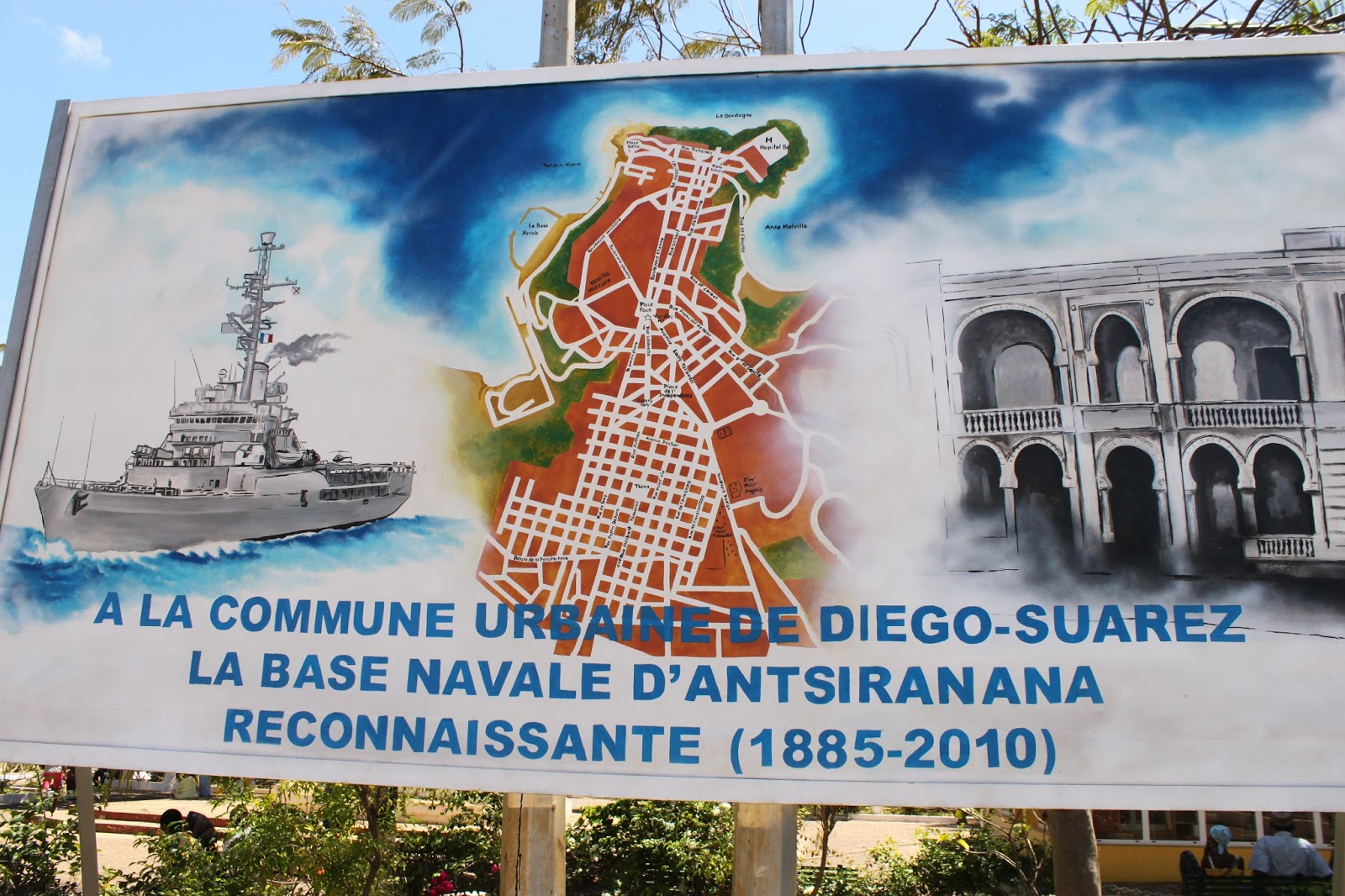
Diego Suarez was named after two Portuguese admirals: Diego Diaz and Fernando Suarez, which is rather forgiving given that on arrival in 1506 they murdered and enslaved the locals. Despite attempts to revert back to its native name of Antsiranana most people still call it Diego. It is a pleasant port city: a fusion of Indian, African and Arab influences. Bustling and lushly tropical. During my visit hot winds seemed to blow continually. Just outside the city are empty beaches of white sand and azure waves. But I wasn’t here as a tourist. On my first morning I had an appointment at the city’s naval base.

There’s been a military base on the site since the French established one in 1885. From my research for Afrika Reich I knew the Nazis wanted to build a naval fortress here (it’s specifically mentioned in the Bielfeld Memorandum, their blueprint for the continent if they had conquered it). Over the years this fortress had grown in my mind until it became a towering polygon of steel and concrete housing aircraft carriers, submarines and battleships. The reality was...er... rather different. Although the port impressed with its sheer size, it was utterly dilapidated, and with Madagascar being so poor its navy is hardly formidable.

Nevertheless, the Base Commander, the improbably named Randrianarisoa Marosoa Nonenana, was keen to give me a guided tour – and once again this walking the ground proved invaluable when I came to write the final scenes at Diego: from how the landscape tiers down to the water, to the palm trees sprouting among the barracks; the positions of the gun emplacements and the layout of the workshops.


Across the water there was also a huge runway – which gave me an unexpected motive for Salois’s mission. As an aside, in the months before my visit, the US military had been wanting to use the runway as a staging post for bombers to Afghanistan. The appearance of a strange foreigner fuelled all sorts of rumours amongst the Malagasy sailors. In the few hours I was at the base word got back to me that I must be a CIA agent casing the place out. The other alternative – that I was a British writer researching a book – was dismissed as too improbable.


D is also for DIE HARD


Did you get the reference? This is a clue
Many readers of the first book detected multiple references to DIE HARD. As I wrote at the time, none of these were intended, indeed to the best of my knowledge there’s no allusion to the film anywhere in Afrika Reich. Nevertheless people were adamant, so when I came to Madagaskar I thought I’d put an extended reference to the film in the book. Doubtless, this time round no one will identify it as such! Did you spot it?

M is for MANDRITSARA

On a map the journey from Antsohihy to MANDRITSARA looks nothing: 100 miles along Route 32. The reality is a bit more daunting. Although a paved road was built in the 1960s very little maintenance has been carried out since. The annual cyclone season has battered it for decades. We set out at 7am. In a few places the tarmac was fine, but mostly it was as pitted as the lunar surface, including several ‘potholes’ that threatened to swallow up our four-wheel drive. At one point our jeep literally disappeared beneath the surface of the road – something I now regret not photographing. The journey took seven hours – but whatever it lacked in speed was made up for by the sheer drama of the landscape.

Landscape on the road to Mandritsara

I should point out a small detail about the book and my research trip. The Madagaskar Plan is mostly set in April, during the rainy season. I travelled in September when it was dry because many of the roads are impassable during the wet months. So I had to imagine the landscape I saw not as gold and brown and taupe – but as a lush emerald.

Mandritsara is one of the most remote places I’ve ever visited. Even my guide, a native Malagasy with twenty years of tour experience, had never been there. On the long, torturous drive we stopped at a village and so unusual was it to see a tourist that everyone in the village (or so it seemed) wanted to say hello and shake my hand.

Finally, under grey skies and an oppressive heat, we reached Mandritsara. It sits in the Sofia Valley (see R is for...) and in the book is the location of a secret Nazi hospital that conducts unspeakable experiments. There is a real missionary hospital in the town – which is where I stayed during my visit (the town not being over-blessed with alternative accommodation). The hospital – with its courtyards and carmine brick walls – was to become the basis for the hospital in the book, though the latter is on a much bigger scale. I should also add that there is no connection between the two. Indeed the real one is a missionary hospital that does work for the local community and surrounding area. I was shown round by its administrator, Dr David Mann. I always feel humbled by people who give up their lives for the sake of others.

Part of the hospital, as seen from the top of its water tower

It was sobering to see the primitive conditions of the hospital in comparison to what we expect in the west. If ever you complain about the NHS or equivalent – you should come to a place like this. But enough moralising. The tour of the hospital prompted many unexpected ideas for the book. At the end I climbed to the top of the water tower and had a spectacular view of the valley as the sun began to dip. In the distance I could make out another complex of buildings and as dusk approached I went to visit. [Spoiler alert.] It turned out it was an abandoned colonial school from the 50s, and exploring it as the night descended, alone and with a vague sense of foreboding, I had a moment of inspiration for when Burton reaches the hospital at Mandritsara...


M is also for MICROCLIMATE

Later on in my trip I visited Montaigne D’Ambre national park. It has nothing to do with the book (though Salois does mention it towards the end) but since it is a couple hours drive from Diego, and since the chances of me returning are slim, I thought I’d take the opportunity to hike and camp there. One detail about the place I must share.

One of Montaigne D'Ambre's many waterfalls

Montaigne D’Ambre has a MICROCLIMATE, the park being enclosed by a ring of mountains; a microclimate much chillier than the surrounding landscape. I noticed it as soon as I entered the park – but more so as we left. By that point I’d been there three days, three days of cold rain and being wrapped up in T-shirt, shirt, hoodie, jacket, two pairs of socks and a hat. As we (guide, driver and me) left the park we passed out of the micro climate and in the space of no more than ten foot went from being cold to sweltering. It was like stepping through a barrier. We had to stop the jeep, pile out and strip back down to our T-shirts. One of the more bizarre experiences of my trip.