DIEGO Suarez – a huge
natural harbour on the northern tip of Madagascar – is the setting for some of
the climactic scenes of the book. It was also the final stage of my
journey around Madagascar.
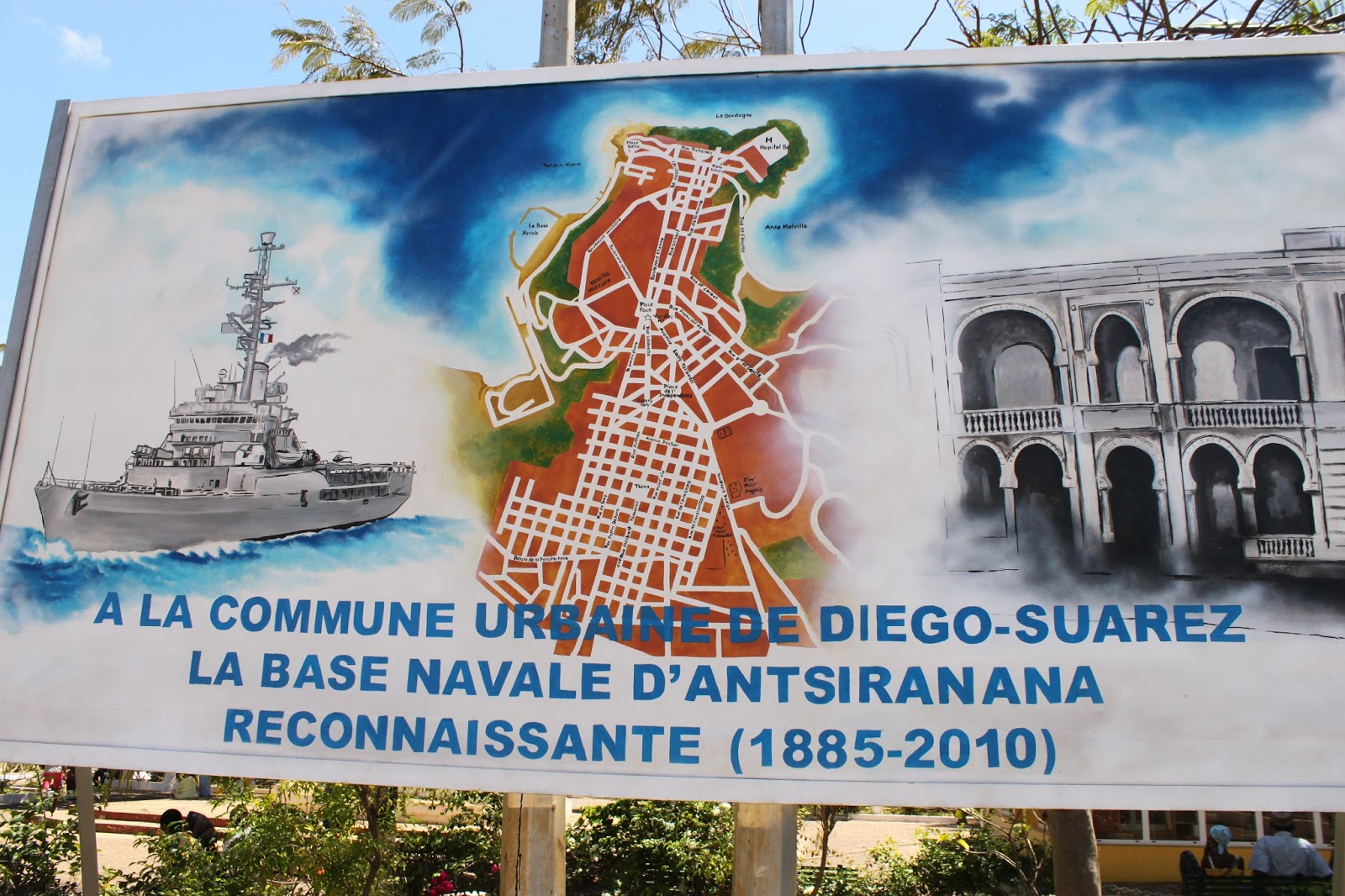 |
| Welcome to Diego! |
I reached the city in the late
afternoon and have two particularly vivid memories of my arrival. The first was
the dense perfume of ylang-ylang plants; the second was having a hot shower! By
that point I’d been on the road for days and although I’d sometimes had the
luxury of running water, that water had never been heated. In Diego I not only
stayed in what was recognisably a hotel, it had decent plumbing. I can’t tell
you how much I enjoyed that shower. Afterwards I sat on the veranda of my room
which overlooked the Indian Ocean. Writing is often a miserable business but on
occasions I can think of no better profession.
Diego Suarez was named after
two Portuguese admirals: Diego Diaz and Fernando Suarez, which is rather forgiving
given that on arrival in 1506 they murdered and enslaved the locals. Despite
attempts to revert back to its native name of Antsiranana most people still call
it Diego. It is a pleasant port city: a fusion of Indian, African and Arab
influences. Bustling and lushly tropical. During my visit hot winds seemed to
blow continually. Just outside the city are empty beaches of white sand and azure
waves. But I wasn’t here as a tourist. On my first morning I had an appointment
at the city’s naval base.
There’s been a military base
on the site since the French established one in 1885. From my research for Afrika Reich I knew the Nazis wanted to
build a naval fortress here (it’s specifically mentioned in the Bielfeld
Memorandum, their blueprint for the continent if they had conquered it). Over
the years this fortress had grown in my mind until it became a towering polygon
of steel and concrete housing aircraft carriers, submarines and battleships. The
reality was...er... rather different. Although the port impressed with its
sheer size, it was utterly dilapidated, and with Madagascar being so poor its
navy is hardly formidable.
Nevertheless, the Base
Commander, the improbably named Randrianarisoa Marosoa Nonenana, was keen to give
me a guided tour – and once again this walking the ground proved invaluable
when I came to write the final scenes at Diego: from how the landscape tiers
down to the water, to the palm trees sprouting among the barracks; the positions
of the gun emplacements and the layout of the workshops.

Across the water there was
also a huge runway – which gave me an unexpected motive for Salois’s mission. As
an aside, in the months before my visit, the US military had been wanting to
use the runway as a staging post for bombers to Afghanistan. The appearance of
a strange foreigner fuelled all sorts of rumours amongst the Malagasy sailors.
In the few hours I was at the base word got back to me that I must be a CIA agent
casing the place out. The other alternative – that I was a British writer
researching a book – was dismissed as too improbable.
D is also for DIE HARD
 |
| Did you get the reference? This is a clue |
Many readers of the first
book detected multiple references to DIE HARD. As I wrote at the time, none of these were intended, indeed to the
best of my knowledge there’s no allusion to the film anywhere in Afrika Reich. Nevertheless people were adamant,
so when I came to Madagaskar I
thought I’d put an extended reference to the film in the book. Doubtless, this
time round no one will identify it as such! Did you spot it?


