Showing posts with label Alternative History. Show all posts

Tuesday, 17 May 2016

Germania - revisited

One of the most popular entries from the A to Z of Afrika Reich was the blog on Germania, so I thought I’d return to it with some more pictures, especially given the city actually appears in The Madagaskar Plan. Germania, as I’m sure you know, was the capital Hitler planned to build if he won the war; it would have been overseen by the Führer’s architect, Albert Speer. Here they are admiring a model of the city:


Here is a plan of the intended layout of Germania:


At the centre of this new metropolis was the Great Hall. The first illustration gives you some sense of the scale of the building. Below it are various artists’ impressions of how it would look: 


 Finally, a miscellany of views of Germania:


Sunday, 26 July 2015

B is for BUTTERSCOTCH

Much is made of the ‘Point of Divergence’ (PoD) in alternative history: the moment where real events end, and imaginary ones begin. Indeed I’ve written about the subject before (see previous blogs). Most people view the PoD of my world as the British defeat at Dunkirk. However, as previously stated I don’t view Dunkirk as the moment history takes a different path; I see it merely as the symptom of a much earlier change. The true deviation is more subtle and comes before the Nazis have taken power.

Some people have asked whether the PoD is the beach burning scene in the first book... those readers are on to something. But to get to the bifurcation you have to go back even further. In The Madagaskar Plan, the true Point of Divergence is revealed for the first time. It is Hochburg’s use of the word ‘BUTTERSCOTCH’ to describe the skin above Eleanor’s heel. I like the idea of how the course of the 20th Century might turn on a single, illicit adjective. It strikes me as a more intriguing idea than whether a battle was won or lost.


The point I’m trying to make is that history is not decided by headline events, men of destiny or the fate of armies – but in the obscure moments of our personal psychology. We make seemingly unimportant choices and these ripple through time in ways we can never imagine, informing much later decisions that can have profound effects on the world.

The misuse of the word ‘butterscotch’ leads to a multitude of other events and in the prologue of Book 3 you will see the full geopolitical implications of it (which admittedly tie back to Dunkirk). All this grows from that one misplaced word. History pivots on the trivial, the insignificant, as all our lives do. Though I should add, you don’t have to read the book in this way. If you’d prefer to keep Dunkirk as your PoD, that is your privilege as a reader!


B is also for BAYERWEED

One of the main new characters in Madagaskar is Tünscher, an old friend of Burton’s from the Foreign Legion and now an Obersturmführer in the SS. He’s meant as a trickster figure, someone neither the reader, nor Burton, knows whether to trust completely. [Spoiler alert.] To add an extra piquancy to this, and make him more unpredictable, I gave him a drug habit. Tünscher is a user of BAYERWEEDS.


During my research I read how Germans on the Eastern Front were prescribed cigarettes laced with heroin for lung injuries, and how some soldiers started smoking them to counteract the freezing air of the Russian winter.  A trade in these cigarettes soon began and it seemed a likely thing for Tünscher to get involved with. I coined the slang term ‘Bayerweed’ from the German pharmaceutical company that first developed heroin. Its name: Bayer AG.

Thursday, 19 December 2013

V is for VANILLA JEWS (Book 2, update 2)

The original title for the sequel to Afrika Reich was THE VANILLA JEWS. However, my editor didn’t think it sounded commercial enough, so I changed it. For the past couple of years this blog has been about the original book, now it’s time to start looking forward (spoiler free... ish) to the next one.

So what to tell you? When I first started on Book 2, I meant it as a direct follow-up; as the years have passed, however, it has subtly shifted. I now see it as a ‘parallel sequel’ – although it continues events of the first book, and develops the existing story and characters, certain aspects of the original have been dropped. It is significantly more ambitious with an interweaving, multi-stranded narrative and more emphasis on the characters than action (though there’s still a healthy dose of the latter).

The one thing it is not is a rehash of the first book. There’s a lot of pressure in publishing to create a series and/or repeat an initial success – but I have scant interest in this. What engages me is the possibility of doing something different, something unexpected. As I was recently advised by a wily American film producer: ‘never go for the sure thing’. It could be a maxim for Book 2.

A propaganda poster from the 1930s

At the centre of the story is the Nazis’ plan to deport the Jews of Europe to Madagascar, an island off the east coast of Africa. Prior to the Holocaust this was to be their fate. Some historians argue that Madagascar was nothing more than a fantasy or smokescreen to cover up the real killing. However, my research shows detailed preparations were made by the Nazis and that the subject was discussed and approved at the highest level. When Hitler was shown the plan in the summer of 1940 he responded that it was ‘very good’. 

Perhaps more disturbingly, as early as 1938 the British were also in discussions to exile the Jews to Africa. We can never know the truth path of a speculative history but the thought of a Jewish Madagascar is not improbable. As an aside, Madagascar is the world’s largest producer of vanilla – hence the original title; vanilla remains of leitmotif throughout the text.

The odious Globus
With this as the background, other elements in the new book include a deepening of Burton’s back story; the fallout of Hochburg’s invasion of Northern Rhodesia; visiting new realms of German Africa such as the ‘pleasure city’ of Roscherhafen (again based on real plans); glimpsing WBU, the Nazis’ military zone in Siberia; as well as a slew of projected Nazi hardware and several new characters. Among these is Odilo ‘Globus’ Globocnik, a real historical character and the villain of Fatherland – though my depiction of him is very different (and dare I say, more accurate) than Robert Harris’s. Did you know, for instance, that Globocnik was a master horseman, drunkard and singer of Austrian folksongs?

Without wanting to be a hostage to the future the new book will be published in time for Christmas 2014. And the title? When my editor said The Vanilla Jews didn’t work I had an instant alternative (no pun intended). It has already been registered and ISBNed. You heard it here first:

THE
MADAGASKAR PLAN


Wednesday, 20 November 2013

Reflections & V is also for...

When I first began this A-Z of Afrika Reich I meant to publish an entry a week with the last, ‘V is for...’, going live as the UK paperback was published. As with the writing of Book 2, this schedule now seems rather optimistic. But as the A-Z draws to an end I thought it was a good opportunity to reflect on it.


In the two and a half years I’ve been writing this blog, more than 32 500 people have visited it; I hope some of them have read it and been intrigued and entertained by the contents. It has certainly been a revealing process for myself. I’ve learnt as much about the book dissecting it here as I did while writing, perhaps more. At the same time, trying to get a handle on it has been like sculpting steam: for every assertion I make, I’m immediately aware of several contradictions. I like to think, however, that I’ve shown that Afrika Reich is more than just Fatherland or SS-GB in the tropics.

The comparison with those books has been both a boon and a curse. The great advantage was that it created an association with existing bestsellers. Against that, I never saw Afrika Reich as being of the same ilk. A naturalism has crept into novels imagining a victorious Nazi Germany, something borne through SS-GB and Fatherland and continuing to this day with the recent Dominion. I wanted to move away from that, though the demands of marketing departments meant I often had to play to the gallery and define myself in terms of Deighton, Harris et al (not that they’re bad company to keep!).

Why the naturalism? It may partly reflect a general movement in fiction. I think it also comes from a sense that if an author captures certain details then he is accurately portraying what the world would have been like if Hitler had won. I remain unconvinced. The whole point of an alternative history is that we can never know what it would have been like. A more fantastical approach served earlier examples of the genre well, such as Swastika Night, The City on the Edge of Forever (for all the Star Trek fans I know who read this blog) and The Man in the High Castle. By tendency, I’m more comfortable in this camp.
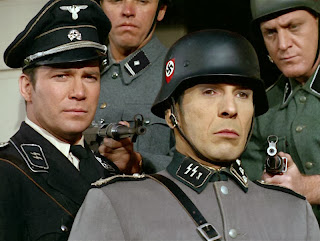

This blog has allowed me to convey a sense of that and speak my mind more openly than the marketeers probably want me to. If you’ve read this far you’re in a better place to understand my intentions (yes, that word again); it’s something I plan to continue more explicitly in Book 2 – the subject of my next entry and the last in the series. While I leave you to speculate what the V can stand for, here’s the addendum in advance...


V is also for Violence

Along with the literal brigade (see ‘L is also for...’) the reaction that most surprised me about the book was how violent people found it. Obviously given its setting and subject it was never going to be a fluffy, rose-perfumed narrative, despite that I never felt the violence was as bad as some people protested. I’ve had grown men tell me they had to stop reading because they found it excessive. What this says about me I don’t know – though others have speculated (see here, for example).


All I can say is: 1) I didn’t want to shy away from the violence that was the reality of the Third Reich and continues to this day in central Africa; nevertheless I always perceived mine as a stylised, almost comic violence, not to be taken entirely seriously 2) before submitting the book for publication I made a conscious decision to tone things down. If you think the version that ended up in the shops is bad, you should see the earlier drafts!

Friday, 7 June 2013

D is for DIVERGENCE POINT (part 2)

By coincidence, in the past week two readers* have emailed me questioning whether Britain’s defeat at Dunkirk really is the DIVERGENCE POINT of the book. (As a quick reminder the divergence point in a work of alternative history is the moment where events take a different path to our own version of reality.) Those two emails were actually very astute, and follow on from similar messages I’ve had over the years. So although I planned not to reveal this until a later date (if ever), today I’ve decided to confess all.

Robert Frost would approve...

Dunkirk is not the true divergence point of the book. It is a symptom of an earlier cause. It is the place where geopolitical history changes but the real shift – a minuscule fissure in the past – predates it. If, thus far, I have promoted a slight falsehood it is because I have been playing to an audience; fulfilling the marketing needs of the book (though in my defence all the clues as to what’s really going on are in the text). As regular readers of this blog will know by now, nothing is ever quite what it appears with Afrika Reich!

So what is the true divergence point?

I’m not going to tell you for two reasons: 1) better you work it out yourself 2) rather unfairly, it’s more fully explored in Book 2. However, I believe world events are not decided at the macro level but micro. History is determined not when Caesar crosses the Rubicon – but earlier, in the accretion of childhood experiences that motivate the crossing in the first place.

Whilst you’re puzzling all this out (or heading back to Facebook, which is probably more entertaining anyway) I’ll leave you with a clue:


*One in Iowa, America; one in Venezuela – hello/hola if you’re reading!


Tuesday, 30 April 2013

F is for FANTASTIC REALISM


I’ve written about intent before. As this A-Z enters its twilight I thought I’d address the subject again. Those who prefer to think of Afrika Reich as a ‘straight’ thriller might want to look away now...

Prior to Afrika Reich, I wrote four unpublished novels on subjects as diverse as Barbary pirates and literary forgery. The one common thread was the mode of writing: FANTASTIC REALISM, something I continued in my tale of Nazi Africa.

So what is fantastic realism? It’s a rather amorphous term and unlike its better known cousin – magic realism – evades definition. Personally, I feel it employs realistic conventions but mixes them with elements of the fantastic, grotesque, comic and horrific. Perhaps it’s easier to explain with an example and so once again I reach for Sergio Leone, a great practitioner of fantastic realism. Here’s an image from his film, Giù la Testa:


It shows Sean, an IRA terrorist, having dinner with Juan, a bandit (off screen), in the Mexican desert. This combination of unexpected characters meeting in a realistic setting is already taking us into the realms of fantastic realism but the clincher is the details. They are sitting down to eat in the wilderness but are dining off porcelain plates with all the finery (the wingback chairs, the decanters of vinegar and oil) of a lord’s banqueting hall. I particularly like the crêpe suzette pan. It is a combination of unlikely elements – though crucially there is nothing supernatural about the scene.

My book begins its fusion of reality with the fantastical on page one with opening epigraphs that combine the real (Hitler’s quote) and the imagined/fantastic (Hochburg’s). Elsewhere we see two arch enemies overlooking a square paved with human skulls discussing Himmler’s constitution. Or Patrick tortured within a cement factory where the main production material is not mineral-based but a trough of human bodies. Sometimes it’s simply in the small details – the SS guards with their pink ladies parasols (a direct reference to Leone). Unlikely? Yes. Impossible? No.

Alternative history has always struck me as something of a fantastic genre – it posits an unknowable reality – so I felt it was an ideal match for fantastic realism. However, due to the success of books like Fatherland, and more recently Dominion, a naturalism seems to be creeping into the genre: the idea that a writer can accurately describe a speculative world that never existed. It certainly seems the mindset some people have tried to read my book in – no wonder they’ve been confused! But that is to miss the point. It’s not my book wasn’t thoroughly researched or employs real, historical details – it’s that I’m not a slave to verisimilitude. Indeed the notion of verisimilitude in alternative history must, by definition, be a contradiction.

What interests me most, what excites me enough to want to spend several years writing a book, is the point where reality and the fantastic meet – and the friction the two generate. That is what Afrika Reich is about: something a little more subversive than reality. 

Wednesday, 17 October 2012

E is for EDITOR


If you’ve trawled the bestseller charts in the past twenty years, chances are you’ve read a book my editor was behind. He’s worked with thriller veterans Len Deighton and Gerald Seymour; launched new writers like Conn Iggulden and Philipa Gregory; and most recently guided David Nicholls to a mega-hit with One Day. I was also delighted to discover he used to be Flashman’s editor! His name is Nick Sayers and as another publisher once told me, ‘he’s the best in the business’.

Nick & I at Clays where TAR was printed

1) Nick wanted the structure of the book tweaked, so that the reader would get to the alternative history sections more quickly. There are two extended passages of them (one explaining Britain’s peace with Nazi Germany, the other about the Casablanca Conference). In my edit these appeared, respectively, in chapters 8 and 12. Ultimately this became 3 and 8. I have to say that although I found my original structure more elegant, I can understand why getting some explanation in early was beneficial.

2) He also suggested that further context be added: details about Nazi Africa. I had already included plenty, but Nick insisted on more, everything from agricultural policies in Kongo to the ethnic mix of the conquerors. This had an implication on the text which I’ll come back to in ‘F is for...’

3) The use of the word ‘nigger’. I realised this was a contentious and sensitive subject so had employed it sparingly despite the virulent racism of the characters; originally it appeared 42 times (in a 120 000 word book) Nick felt this was too much, so I trimmed it to 26. Any more and the Nazis would start sounding a bit too PC, something one could never accuse Hochburg of!


4) Finally, and perhaps this was the point Nick was most adamant about, he wanted Burton to be more morally upstanding. My original vision of him was in the Leone mould. He was utterly amoral, disinterested in what the Nazis were doing, a man who killed for money with little principle. His assassination of Hochburg had nothing to do with right or wrong, simply a desire to avenge. The only chink in this was Madeleine: I liked the juxtaposition of his amorality with love. Patrick was similarly unscrupulous. Nick said he struggled to work out who was good and who bad and that the ‘heroes’ had to be more clearly defined as good guys. I tried to argue my case but was advised it would be commercially risky, so I relented and made Burton the more morally buoyant character who appears in the novel (though hopefully as I’ve shown there remains a certain ambiguity to his character). In retrospect this is the one change I have some regret over. My original plan for the trilogy was to have Burton begin as amoral and gradually change till the final showdown at the end of Book 3. By then, and influenced by his experiences, he would be attached to a more Manichean code.

Once implemented, the above changes amounted to less than 2% of the book. I think they were the right ones for the time (remember I was struggling to get my first publishing deal!) and in retrospect I don’t think they harmed the book, they simply made it different from my original. Whether readers would have reacted differently to that vision is something I’ll never know...


E is also for EL REICH AFRICANO

Once the book had been commissioned in the UK the next question was whether it could be sold abroad. To date four territories have bought the translation rights, not bad given that many big book markets such as Germany, Russia, Poland etc had understandable issues with the Nazi content. I’m reliably informed that one German publisher blanched when they got to the Schädelplatz!

The first to buy it was Spain where the book went to a three-way auction. Whether it was because of this… the superb trailer my Spanish publisher (Ediciones B) made for it… the publicity tour I went on to Madrid and Barcelona… or just because the cover matched my original design, EL REICH AFRICANO has a special place on my bookshelf.


Monday, 2 July 2012

G is for GERMANIA


GERMANIA – or to give the city its full title Welthaupstadt Germania (World Capital Germania) – was the name the Nazis planned to give Berlin if they won the war.

Along with Hitler not appearing in the book (see ‘H is also for…’) another early decision I had to make was whether any scenes would be set in the capital of the new German Empire. It is, of course, the primary location of Robert Harris’s Fatherland, indeed I’ve often wondered why he didn’t call his book Germania. In a rather sneaky exposition scene Harris has his hero and son take a bus tour of the city so the reader can become familiar with its sights: the Great Hall, Avenue of Victory, Arch of Triumph und so weiter.

Germania is brought to life so vividly in Fatherland that I didn’t see much point in revisiting it, so during the planning of Afrika Reich I chose not to use it as a setting. This also coincided with me exorcising anything in Britain/London, apart from the prologue. I liked the intensity of having the whole book set in Africa with no European ‘relief breaks’, something my agent initially pressed for. I’ll come back to this in ‘U is also for...’

Speer admiring a model of his planned city as seen in the film Downfall.

On a practical note, it’s unlikely Germania as envisioned by Hitler and his architect, Albert Speer, could ever have been built. The planned buildings were so monumental that they required granite hard foundations; Berlin is built on marshy ground. To test whether such huge edifices could ever be erected several exploratory load bearing blocks were constructed. If they sank less than 6cm, the ground of Berlin would not have been capable of sustaining the structures Hitler imagined. They were built in 1941 and although they exist to this day, within three years had slipped 18cm!

Nevertheless there’s great appeal in the prospect of such a histrionic city with its Olympian architecture and convictions of grandeur. I was particularly struck by one, slightly apocryphal detail. Visiting dignitaries would arrive at Templehof airport, then drive directly through the city along the Avenue of Splendours to Hitler’s Palace and finally his study: an uninterrupted straight line of five kilometres from your plane to the desk of the Führer. Can you imagine such megalomania? In the earliest drafts of Book 2 Hochburg made this journey.

Unfortunately as I began developing the plot this scene became more and more unnecessary until finally I realised it had to be cut. Working on a novel, however, is a process of constant evolution, so even as Hochburg’s scene fell from the manuscript another scene in Germania presented itself. Something more gentle and unexpected. You’ll have to wait for the sequel to find out what, but it may just involve Burton... and ice cream!

See the next entry for a virtual tour of Hitler’s planned city.

Germania - a virtual tour


Normally I only include one or two pictures with each blog entry. However, when I was researching Germania I came across so many striking images that I thought I’d share some of them here, starting with this artist’s impression of the approach to the Volkshalle or Great Hall:


This monstrosity was so huge that it would have been the biggest structure in the world if it had ever been built. Rising more than 1000 ft it had a capacity of 180 000 people. One of the unpredicted consequences of having so many people in a single space is that their breath would have risen into the dome, condensed, then fallen as rain, making it the only building even to generate its own climate. To get a sense of its sheer size here’s a model with the Brandenburg Gate in the foreground to show the scale:


The Great Hall stood at the end of the Avenue of Victory. The following two images show its position within the city:


Another of Germania’s landmarks would have been the Arch of Triumph. Once again, it was planned to be on a gargantuan scale and have a cubic capacity 49 times larger than the Arc de Triomphe in Paris. One wonders why they didn’t go the whole hog and make it 50 times. Rather presumptively, Hitler had drawn a sketch of it as early as 1924. Here’s his original:


If you’d like a virtual tour of Germania, I recommend this video:


Sunday, 13 May 2012

H is for HERERO

I’ve always been fascinated by the great Victorian expansion into Africa and from my previous reading was dimly aware of the HERERO and the fate they suffered under the Germans.  However, it wasn’t until I was fleshing out Neliah’s character and ethnic background that my memory was jogged. 


The Herero are a tribe from South-West Africa in what is modern day Namibia. At the end of the 19th century this region became a German colony (DSWA, part of the Second Reich) and after years of encroachment on their territory the Herero finally rebelled against the European settlers. The Germans responded with unbridled savagery: slaughtering thousands, leaving many more to starve. Between 1904 and 1907 it has been estimated that 80% of the Herero were wiped out. The parallel between this and Hochburg’s plans for the continent seemed obvious – hence why I made Neliah a Herero.

(NB: this is a very simplified version of events, those seeking a more detailed account can find out more on Wikipedia. I would also recommend the book The Kaiser’s Holocaust, published by Faber.)

A couple other details that might interest:

1.      Several unexpected threads can be drawn between events in DSWA and the Third Reich. For example, the colonial governor in the years leading up to the Herero uprising was Heinrich Göring, father of the notorious Nazi. While one commanders of German forces was Franz Ritter Von Epp who went on to found the KPA, the administrative body that would have ruled Africa had the Nazis conquered the continent

2.      I taught myself a smattering of Herero while writing the book so all the lines Neliah and Zuri speak in their native tongue are correct (I hope!). However, my study-source was a book published in the 1890s which meant some words – helicopter, for example – didn’t exist. In these cases I had to neologise, creating new words from combinations of existing ones

Curiously, some of the first readers of Afrika Reich thought the Herero massacres were a fabrication; one publisher cited this as a reason for rejecting the book (i.e. he felt it was a strand of alternative history ‘too far’). I think this demonstrates how poorly known this genocide is while also proving the dictum, ‘Those who are ignorant of the past are doomed to repeat’. Many historians believe what happened to the Herero was a precursor to the Holocaust, indeed the BBC even made a documentary called From the Herero to Hitler, which rather neatly leads me to...


H is also for HITLER

One of the first decisions I made with the book was that HITLER would not directly appear in it. The same went for other well known Nazis.

Some readers have told me they would have liked a cameo, or even a more substantial role, but personally I felt it a bit crass. It also misses the point of what I’m trying to do. (I had a similar reaction to those who suggested I include people such as Nelson Mandela or Ben Gurion.) I think alternative history works best if these real figures are like shadows: their darkness falls across events without their physical presence.

Having said all that, I do have a scene in mind (the prologue of Book 3) where an on stage appearance from Hitler might be necessary. We’ll see...

Sunday, 4 March 2012

Norway - a writer's paradise?

Last year I went to Madrid and Barcelona on a publicity tour to promote the Spanish edition of TAR. That was before this blog got going properly, so I didn’t write about it. Last week I was in Oslo for the release of the Norwegian edition and I thought I’d write a few words about the experience.

The two trips were very different in nature. In Spain I got blanket coverage in most of the national and regional press as well as radio and (cringe!) TV. In Norway I was doing a single in-depth and exclusive interview with VG, Norway’s biggest circulation paper. It’s always intriguing to know what questions you’ll be asked. In Spain much of the interest was to do with the politics of the book; in Norway, the alternative history aspect, violence and literary heritage of TAR were the main topics of conversation. I think it went well.

Me and the journalist Jon Rydne

After the interview, a photo shoot. Originally this was going to take place in the jungle house of the Botanical Gardens (I did something similar for my TV interview in Madrid) but when the Gardens learned the book was about Nazis (still a sensitive subject in Norway) they refused us permission. Luckily my publicist snapped into action and bought a load of plants to turn my publisher’s office tropical! Swastikas were also found as well as a bust of Hitler. You can see the photos on Facebook.

Afterwards, the sales manager took me round various bookshops in Oslo. There were piles of Afrika Reich everywhere. Particularly exciting was to walk past Norli, a flagship store, and find a stack of TARs in the window (check out the video below). Seeing my book like that is a bizarre experience. I find it funny to think that something I worked on for years, mostly in isolation, is now not only out in the world but in a place with snow on the ground, fjords barely half a mile away and city views totally unfamiliar to me.

Touring all the bookshops also made me think how different the Norwegian publishing business is to the UK. Their net book agreement has not been dismantled which means the industry is like ours was a couple of decades ago. There are over 600 books stores and half a dozen major chains – this in a country of 5 million. It’s rather damning that the UK with a population twelve times bigger can barely support Waterstones. Books are valued. Hardbacks retail at £30-40, there’s little discounting and no Amazon. Once a year the Norwegians have a nationwide book sale that gets people queuing round the block to pick up a bargain; about the only thing that generates this kind of interest at home is Next’s sale. What does that say?

There are also lots of publishers, more than a hundred. Some are very small but with such diversity there’s more opportunity for people to get published and more risky books get a chance. I’m not saying it’s perfect (the two biggest publishers, for instance, have vertically integrated businesses i.e. they not only publish but also own the distribution networks and bookstores) but to me Norway seemed liked a writer’s paradise!


A-Z resumes next week.

Sunday, 11 December 2011

C is for CASABLANCA CONFERENCE

Another break from the blog – this time due to a back injury (I’ve torn a muscle) which means sitting to write is painful. Actually, it’s not only a physical issue; I’m currently working on Book 2 and it’s difficult to write about one-time legionnaires involved in all sorts of rough and tumble when just sitting down hurts! Anyway, enough of my ailments and on with the A-Z.

If my alternate history begins with the divergence point of Dunkirk, it consolidates with the CASABLANCA CONFERENCE of 1943 where Hitler and Prime Minster Halifax meet to carve up Africa. The obvious inspiration for this was the 1884 Berlin Conference where the 19th Century powers met to divide the continent (the so-called ‘The Scramble for Africa’) . There was also a real Casablanca Conference, also in 1943, also at the Anfa hotel (pictured below) where Churchill and Roosevelt met to discuss opening up a second front in Europe. This is one of things I enjoyed doing most with the book – taking real historical moments/facts and bending them to my story.


By the way – watch out for a literal reference to ‘Casablanca’ in Book 2 which will help explain the symbolism of Hochburg’s and Eleanor’s relationship... in case you’ve overlooked it.

The Casablanca Conference leads to a decade of uneasy peace before my story picks up in 1952. But why did I choose that year? There were two main reasons, one of which I’ll come back to in ‘F is for...’. The second is that I wanted a date that was significant, iconic (if I dare use that most over-employed of words). 1952 was the beginning of an epoch that lasts to this day; it was the year Elizabeth II came to the throne. Indeed the majority of people in the UK have known no other monarch. Just as a period of real history began in 1952, so does my alternative one. Like I said: I enjoy bending reality!

Sunday, 23 October 2011

D is for DIVERGENCE POINT

If you’re writing an alternative history sooner or later you have to settle on a ‘DIVERGENCE POINT’ – i.e. the moment when real, recorded history ends and a new, alternative one begins. In SS-GB it’s the successful invasion of Britain by the Nazis, in Fatherland when Hitler defeats the Soviet Union in 1943.

I settled upon Dunkirk and instead of giving the British a miraculous escape, I had them slaughtered on the beaches. Why did I choose this point?


One of the themes of the book is the myths we cling to (think of Burton and his mother) and I wanted to echo this in the larger structure of the narrative. Dunkirk is often seen as the epitome of British pluck; a defeat that has somehow morphed into a victory and is seen as one of the country’s finest hours. Indeed, newspapers still refer to the ‘Dunkirk spirit’ in a whole variety of situations – from Brits abroad coping with crises to the dreary comebacks of our national soccer team.

I was intrigued by debunking this notion and having Dunkirk as a disaster. Instead of being a narrow escape it was a coup de grace that led Britain to negotiate with Nazi Germany, leaving us with peace but less national pride. Of course, once I had changed this, other aspects of the alternative history fell into place as a consequence. With Britain out of the war much earlier there was less need for American involvement; having to fight on only one front meant Germany could concentrate all its forces against the USSR and win (though as a nod to Harris, I kept the same date of 1943).

In reality, the reasons behind Hitler’s decision not to annihilate the British at Dunkirk remain a mystery. Some historians think it was down to incompetence, others that it would appeal to Britain’s sense of fair play, making them more amenable to negotiation. In my world there’s a very specific reason why Hitler doesn’t attack... though you’ll have to wait till the Prologue of Book 3 to find out!


D is also for DAMBE

In action adventure stories the hero often has some skill in martial arts. I wanted to give Burton the same but felt something like kung fu or karate would be impossibly crass. So I went looking to see if there was an African equivalent. As it turns out there were several including: kokawa, musangwe, ‘nuba’. In the end I opted for dambe, a West Africa form of boxing because a) I’d already place Burton’s upbringing in that part of the continent b) it just looked vicious and chimed with the character’s more violent streak.

You can see an example of dambe on this clip from CNN.


Curiously both I and Burton seem to have out-grown dambe... so it may not be back in Book 2. What does everyone else think?