Showing posts with label Salois. Show all posts

Sunday, 3 July 2016

S is for SALOIS

Reuben SALOIS is the main new character in The Madagaskar Plan, and one of the three mentioned on the back cover: ‘Burton... Hochburg... Salois... the fate of the world is in their hands’. I’ve mentioned Salois before – here, in this blog from the first book. He’s another of my recycled names/characters... though his first name gave me months of anxiety. I must have gone through thousands of Jewish male names to find the right one, only settling on Reuben in the final weeks before the book was finished.

From the start it was important I had several Jewish characters in the book. Partly this was to assuage any criticism of writing about the subject matter solely from a Gentile point-of-view, partly so the reader could experience the world I had created at ground level. Salois is one of the first Jews to be shipped to Madagascar, so we see the whole Jewish experience through his eyes – from the journey to the equator, to the work gangs, the first rebellion and beyond.

The character went through various incarnations from the entirely realistic, complete with ‘normal’ backstory, to the more mythic figure he is in the finished book. [Spoiler alert.] Salois is borne from the ancient tradition of heroism. The Greeks believed a hero was someone who performed great deeds; the idea of morality – whether in the deeds themselves or the person doing them – was irrelevant (the link between heroism and doing good arrives in the medieval period and Age of Chivalry). The other big influence on Salois was Harmonica from Leone’s Once Upon a Time in the West, which leads me to...


I’ve left this entry as one of the last because I want people to have the chance to read the book before turning to this blog. There is a revelation about Salois I must make. Some readers understand it, others don’t. If you’ve read Madagaskar and are happy with your interpretation of Salois, there’s no need to read on. From what people have already reported, he’s one of their favourite characters. But if you want to know my intention, it is this. [Major spoiler alert.] Salois is a phantom; he is not entirely of this world. He is ‘Azrael’, the avenging angel of Jewish mysticism. Of course it is possible to read the character in an entirely naturalistic way, but I wrote him as a man returned from the dead to put right a great wrong. It is the sin of his own life and the sin committed against his race. There are clues to this everywhere in the text.

Two final pieces of trivia. His parting line is based on Prospero’s farewell in The Tempest. We never learn Salois’s actual name. Like Harmonica, and very much in the Leone tradition, he is a man without a name.

Tuesday, 26 January 2016

D is for Diego

DIEGO Suarez – a huge natural harbour on the northern tip of Madagascar – is the setting for some of the climactic scenes of the book. It was also the final stage of my journey around Madagascar.

Welcome to Diego!

I reached the city in the late afternoon and have two particularly vivid memories of my arrival. The first was the dense perfume of ylang-ylang plants; the second was having a hot shower! By that point I’d been on the road for days and although I’d sometimes had the luxury of running water, that water had never been heated. In Diego I not only stayed in what was recognisably a hotel, it had decent plumbing. I can’t tell you how much I enjoyed that shower. Afterwards I sat on the veranda of my room which overlooked the Indian Ocean. Writing is often a miserable business but on occasions I can think of no better profession.

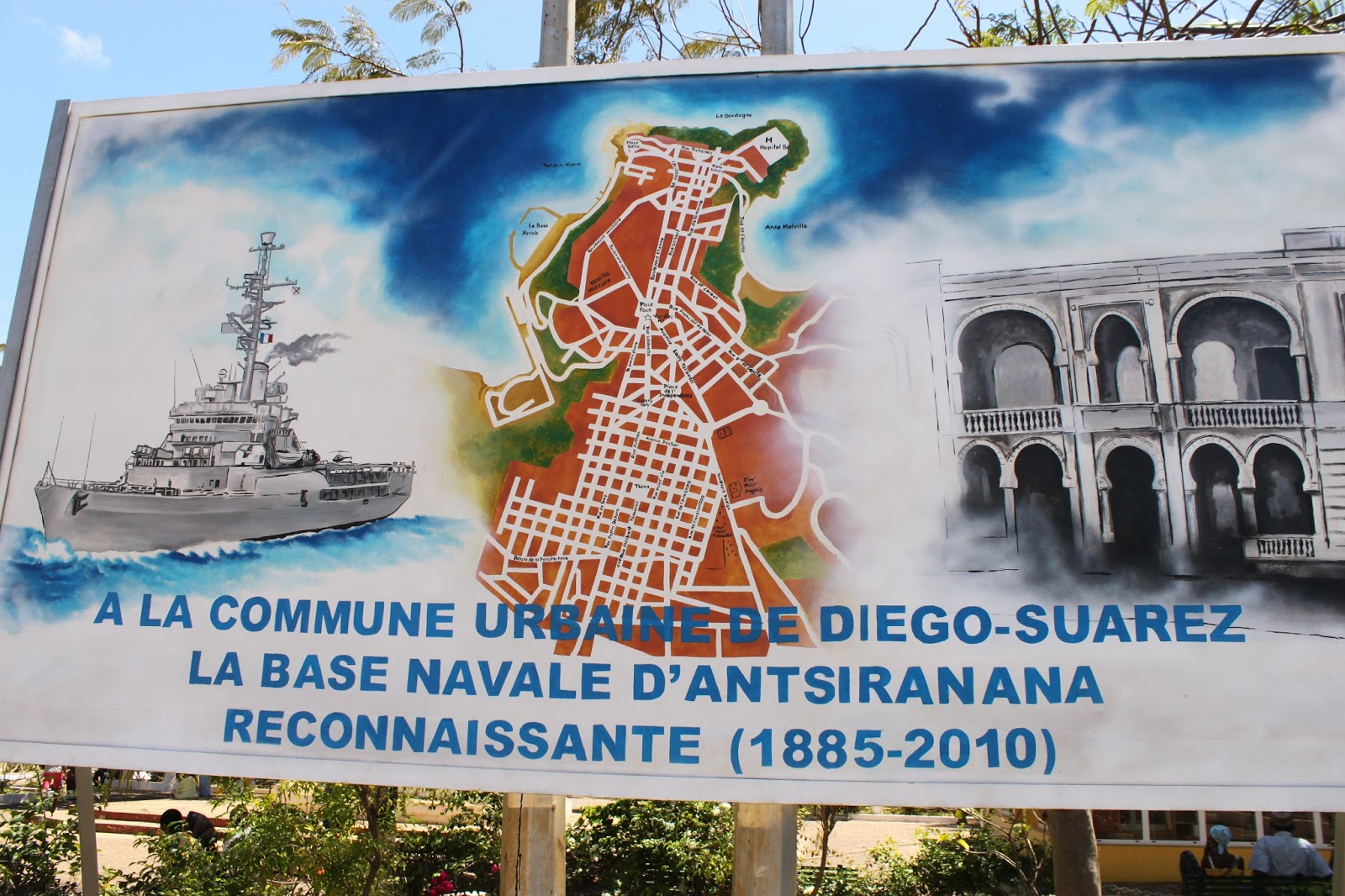
Diego Suarez was named after two Portuguese admirals: Diego Diaz and Fernando Suarez, which is rather forgiving given that on arrival in 1506 they murdered and enslaved the locals. Despite attempts to revert back to its native name of Antsiranana most people still call it Diego. It is a pleasant port city: a fusion of Indian, African and Arab influences. Bustling and lushly tropical. During my visit hot winds seemed to blow continually. Just outside the city are empty beaches of white sand and azure waves. But I wasn’t here as a tourist. On my first morning I had an appointment at the city’s naval base.

There’s been a military base on the site since the French established one in 1885. From my research for Afrika Reich I knew the Nazis wanted to build a naval fortress here (it’s specifically mentioned in the Bielfeld Memorandum, their blueprint for the continent if they had conquered it). Over the years this fortress had grown in my mind until it became a towering polygon of steel and concrete housing aircraft carriers, submarines and battleships. The reality was...er... rather different. Although the port impressed with its sheer size, it was utterly dilapidated, and with Madagascar being so poor its navy is hardly formidable.

Nevertheless, the Base Commander, the improbably named Randrianarisoa Marosoa Nonenana, was keen to give me a guided tour – and once again this walking the ground proved invaluable when I came to write the final scenes at Diego: from how the landscape tiers down to the water, to the palm trees sprouting among the barracks; the positions of the gun emplacements and the layout of the workshops.


Across the water there was also a huge runway – which gave me an unexpected motive for Salois’s mission. As an aside, in the months before my visit, the US military had been wanting to use the runway as a staging post for bombers to Afghanistan. The appearance of a strange foreigner fuelled all sorts of rumours amongst the Malagasy sailors. In the few hours I was at the base word got back to me that I must be a CIA agent casing the place out. The other alternative – that I was a British writer researching a book – was dismissed as too improbable.


D is also for DIE HARD


Did you get the reference? This is a clue
Many readers of the first book detected multiple references to DIE HARD. As I wrote at the time, none of these were intended, indeed to the best of my knowledge there’s no allusion to the film anywhere in Afrika Reich. Nevertheless people were adamant, so when I came to Madagaskar I thought I’d put an extended reference to the film in the book. Doubtless, this time round no one will identify it as such! Did you spot it?

Sunday, 23 August 2015

I is for INFLUENCES

The Afrika Reich was very consciously influenced by other works: from Conrad’s Heart of Darkness to films like Where Eagles Dare, from which I took the ‘Men on a Mission’ formula and played around with it. Writing The Madagaskar Plan I made an equally conscious effort to be less influenced.

That’s not to say the book is without INFLUENCES. I’ve already mentioned The Empire Strikes Back; and Sergio Leone looms large again, especially in the fantastic realism and interweaving narrative strands. I also drew on Marek Edelman’s accounts of the Jewish uprising in Warsaw (which inspired the infighting between the Jews in the face of annihilation) as well as childhood passion for Homer.

In terms of other literary influences, two books were significant: William Boyd’s An Ice Cream War and The Great Gatsby, though traces of them may be hard to discern. The Boyd is set during the East African campaigns of World War I, all German colonialism, suffocating cities and rain lashed jungles. It helped with the tone. As did Gatsby which constantly made me reflect on the purpose of characterisation and concentrated my mind on sentences that were fresh and precise. I suppose these two books were like stabilisers on a bike: I had them either side of me during the first drafts but eventually freewheeled off in my own direction. Having said that, one scene in Madagaskar was heavily influenced by Gatsby – the ‘showdown’ between Jay, Tom and Daisy in the Plaza Hotel... expect in my version I’ve added the danger of a loaded pistol.

Levi, Boyd & FSF

Another important book, for obvious reasons, was Primo Levi’s If Not Now,When? a novel based on the true story of Jewish partisans fighting the Nazis. This informed much of the background of the Jewish uprising and specifically Salois’s character. Levi’s novel is replete with extraordinary, vivid details. For example, one of the things I’d never considered before was how hungry freedom fighters must be surviving in the wilderness. Hunger was also a painful motif from Marek Edelman and so it became a central theme in the Madagaskar. On a more light hearted note, my favourite scene in If Not Now, apparently based on fact, is when Gedaleh gathers the pumpkins. For all its bitter logic there’s something rather Leonesque about it, which is why I have Burton and Tünscher do the same in Chapter 33.

Friday, 30 December 2011

P is for PATRICK WHALER

PATRICK WHALER, an aging American mercenary, began his fictional life as Jacques Salois: a 30-something Belgian legionnaire. How did one morph into the other?

As a writer one of the things that fascinates me is archetypes. Amongst the most popular is the old wise man or mentor, a character that instructs the hero in the ways of the world. As I was developing The Afrika Reich it occurred to me that my narrative lacked this figure. I had two central good guys in the shape of Burton and Salois but they were matched as equals, both the same age and with similar skills. I realised I would have a stronger relationship to explore if Burton had a mentor-figure with him… but I didn’t want to make it quite that straight forward!

So Patrick can’t be entirely relied upon. He’s prepared to abandon Burton to save himself, even threatens to shoot him at one point; as a mentor he’s ambiguous. Actually Patrick is one of a number of father-figures Burton encounters in the book from his real father to Hochburg, none of whom offer much safety or stability: a subtle undermining of the concept of Fatherland so cherished by the Nazis.

Up to this point I was still using the character of Salois albeit an older version than initially conceived. It was my agent who suggested I make him American in the hope that it might give the book more appeal State-side. There was no particular reason why Salois had to be Belgian (indeed in an early draft of the original version of the book he was Asian!) so I made the change. I don’t think it had an effect on my US deal but as an unforeseen boon it gave me an easy route into explaining America’s role in my alternative history.

For some reason I’ve had more suggestions from readers as to how they depict Patrick than any other character, everything from George Peppard to an aging Harrison Ford. Personally I always half-saw him looking like Richard Burton in The Wild Geese. There was the aging-warrior-in-Africa connection, but most of all I liked the link with Burton’s character in Where Eagles Dare... it was like catching up with him twenty years later to see what had become of the man.


Two other pieces of trivia. 1) Originally his surname was Whalen – but a lot of the time when I typed it ‘Whaler’ came out, till eventually it stuck. 2) Patrick is trying to get back to his daughter who’s living in Baltimore and hates it. Why Baltimore of all cities in the US? Because while I was writing those scenes I was watching The Wire.

As for Jacques Salois... well the name didn’t go entirely to waste. He’s one of the main characters in Book 2, back in his Belgian form.


P is also for PREQUEL

While Afrika Reich was being rejected by publishers I began looking for a new project. If the book wasn’t going to make it into print it seemed a shame to squander the characters so I began to think how I might use them elsewhere. I was drawn to the idea of Patrick’s lapsed idealism and wondered what it would be like to see him as a young man full of conviction. Since I’d made reference to the Spanish Civil War that seemed the most obvious line to take… and so I developed an unrelated PREQUEL.

Called Seven Bridges to Toledo, it’s about a bullion heist during Spain’s war. Highly influenced by the Spaghetti Western (more of which another time) it tells the story of Arch Stanton, a British engineer and the hero, Patrick and Tunscher (another of the main characters in Book 2) as they try to wrestle the gold across Spain. The plot was full of twists and double-crosses and also featured ‘cameos’ from Hochburg and Cranley.

I never actually wrote the book but do have it planned out. Whether it ever sees the light of day will depend on the continuing success of Afrika Reich and if I want to go back and revisit the story. Time will tell...