Friday, 18 March 2016

N is for NACHTSTADT

Whereas set pieces such as the Ark, hospital, dam and Diego were in my mind from early on in the writing of The Madagaskar Plan, the NACHTSTADT sequence came late in the process.

The inspiration for Nachtstadt...

[Spoiler alert.] It went through multiple incarnations – the only consistent thread being it was the store where Salois gets replacement explosives. At one point it was on an island in the middle of a lake (a real place I passed on the road to Mandritsara); in another it was an oil-rig like structure protected by Walküre gunships. The actual action changed as well, including at one point Globus being present and taking Madeleine hostage. None of these worked – they struck me as overly dramatic, more akin to the train/helicopter chase in the first book and I was consciously trying to move away from such ‘excessive’ set pieces. For months I was unable to find an alternative.

As always when I’m stuck I turn back to Homer and began thinking of the scene set on Circe’s island – where Odysseus’s crew are turned to pigs by magic. Then when flicking through the hundreds of photographs I took in Madagascar I came across this one:


Through that odd, alchemic process that is creation – and tying into the modus operandi of the second rebellion – the location for the scene became a gigantic pig farm. So far all the places I’ve described in Madagascar were based on real locations. Nachtstadt was entirely made-up, though with a nod to reality: Himmler did have several farms where he experimented with livestock techniques.

In keeping with the Homeric reference, I initially wanted to name the place after Circe’s island but that is called Aeaea which I thought was too difficult to pronounce; the Roman equivalent, Ponza, sounded too comic (and Japanese) to me. So I turned to James Joyce. The Circe equivalent in Ulysses is set in Nighttown, the red light district of Dublin... which translated into German is, of course, Nachtstadt.


N is also for Nightingale

I often take a long time to come up with the right name for a character. In the meantime, while plotting or writing, I need some signifier (I hate using just A, B, C etc). In Fatherland there is an American diplomat called Henry NIGHTINGALE. So when I came to write the scenes with America’s envoy to Madagaskar, and before I had a name for him, I temporarily used Nightingale.


I never found an alternative and as time went on the name just stuck. So I confess indolence on my behalf rather than some clever reference! In the early drafts Nightingale had a much larger role in the book – but it got trimmed back. [Spoiler alert.] If you want to know how he originally fitted into the plot I suggest you compare the description of him in Chapter 34 with that of the unnamed fourth man at the table with Rolland, Salois et al in Chapter 13. I based my description on the assistant director and occasional actor Jerry Ziesmer.

Jerry Ziesmer

Sunday, 6 March 2016

R is for the RESERVATIONS

[Major spoiler alert for all of this entry.] One of the first plot elements of The Madagaskar Plan I came up with was the ending, inspired by the climax of Metropolis (one of my favourite films). Plotting is often like doing a puzzle. I start with a solitary piece and then have to find others around it to create a picture. The RESERVATIONS are a good example of this.

Filming the flood in Metropolis

In my very earliest notes for the book I have the following: ‘Ending = apocalyptic flood’. What could cause such a thing? The only thing I could think of was a dam burst. There is a brief mention in Afrika Reich about Hochburg using dams to harness the power of the continent, so it seemed plausible something similar was happening in Madagascar. I looked to see if there were any real dams on the island but there aren’t, at least not of any significance. Then in my research I came across a lucky find. In 1949 France’s main electricity company sent a team to Madagascar to survey the island’s hydroelectric potential. Their report – a document running to hundreds of pages – was invaluable as it not only listed potential rivers that could be used for electricity but also the drawbacks of them. I knew the dam would have to be in the north of the island and by a process of elimination settled on the one proposed across the Sofia River. Then another great detail – the French team feared the river might carry too much silt, leading to turbine clogging. Rather than discouraging me this inspired me – because it said something about Globus’s character: he was prepared to build a folly.

The next question was why would so many Jews live in the valley of the dam – a potentially dangerous site. If the creative process is alchemic (as I’ve written elsewhere) or a kind of puzzle, it is also like weaving a tapestry; individual threads come together to form an image. Much of this ‘mind weaving’ is an unconscious process. The Nazis were obsessed with putting Jews in reservations. The most famous of these was the Lublin Reservation, often considered a precursor to the Madagascar Plan. It was overseen by Globocnik. So somewhere in my head I made a link between dams and reservations and they tied together perfectly.

The only thing left to do was to visit an actual dam. I wanted a remote one, so when I was in the US a couple of years ago I made a lengthy detour to Idaho and the Hell’s Canyon hydroelectric plant – upon which the dam in the book is based. As with my trip to Madagascar, walking the ground was invaluable, providing details I couldn’t have picked up from books alone: the constant hum of generators; the faint smell of brine from the reservoir. It also made for an eventful drive, like something out of Duel... but that is a story for another time.

Hell's Canyon Dam, Idaho


R is also for Rolland

Vice-admiral Rolland is the man who gives Salois his mission. Some of you may recognise the name. Admiral Rolland is also the character that sets Smith and Schaeffer on their mission in Where Eagles Dare. He was played by Michael Hornden.

Hornden as Rolland in Where Eagles Dare

Originally, I wanted to give Salois the call sign Smith uses, ‘Broadsword’. But in recent years it has become too ubiquitous, so I settled instead for another, less well known call sign, one that subtly ties into the plot: ‘Dragonfly’. I’ll leave you to discover where it’s from...

Tuesday, 23 February 2016

P is for PRORA

Madagascar wasn’t the only country I went to for research. I also visited Germany. Part of this trip included the trip to Dachau which I’ve already described. A few days later I caught the overnight train from Munich to the Baltic Sea and what was once East Germany. My destination was PRORA.

There, in the 1930s, the Nazis built the largest hotel complex in the world, capable of accommodating twenty thousand guests at a time (a record unbroken to this day). It is a truly megalithic structure, the frontage running along the seafront for almost five kilometres. Because it never had a military purpose, nor was it connected to the murderous elements of the regime, the building was not torn down after the war. In fact the authorities didn’t quite know what to do with it, so it has simply been allowed to decay. Much of the site is now in ruins, fenced off with trees growing around it.


One section, however, has been preserved, and it is possible to get a sense of what it was like during its heyday. Each room was 5 by 2.5 metres with twin beds, a wardrobe, sink and beige soft furnishings. ‘A holiday cell’, is how Burton describes it in the book – and he’s not wrong.

But my lasting impression of the place wasn’t the grim rooms but the sheer scale of the exterior. A cycle path runs along the length of the building so it’s possible to ride from one end to the other. At a decent pace it took me twenty minutes, twenty minutes of the same monotonous stone-and-window frontage flashing by. And by. And by...

Prora was meant as a prototype for numerous holiday resorts that the Nazis intended to build around the world if they had won the war – from Sweden to Russia to Argentina and of course Africa which is why it finds its way into my book.

This artist's impression shows what it would have looked like in Africa 


P is also for PHANTOM MENACE MOMENTS

Having spent so long writing Madagaskar there were often moments of doubt, in particular I kept asking the question: is it any good? It would seem a futile activity spending so long on something if it was rubbish. I always reassured myself it worked... but in the back of my head one possibility was impossible to silence.

The Phantom Menace must surely be the most disappointing film experience for my generation. For years we waited for a continuation of the Star Wars saga, but when it finally arrived I, along with millions of others, left the cinema with a heavy heart. Yet I assume Lucas didn’t actively set out to make a bad film. To his own mind it must have worked... it’s just that what he wanted was not what his audience hoped for.

That’s what I kept having as I wrote MadagaskarPHANTOM MENACE MOMENTS. I thought I was doing a good job... but what would others think? You end up too close to your work to know. At least there’s no Jar Jar Binks...


Thursday, 11 February 2016

X is for the Xs ON THE BACK OF UNIFORMS

Before I continue blogging about the research trips for The Madagaskar Plan, time for a brief interlude.

An unexpected consequence of my research was that I amassed more material than I could possibly use. Whilst writing I had to decide how much to include. Put in too little and the world is insufficiently brought to life; too much and the whole thing gets bogged down. However, some of the details I discovered simply had to be used.

One of the most horrific came from my visit to Dachau (see earlier blog here). Most people are familiar with the striped uniforms of prisoners in concentration camps. Inmates were also forced to wear armbands that identified their ‘crimes’. The yellow Stars of David for Jews are well known but there were also red triangles for political prisoners, pink for homosexuals, green for ‘common criminals’ and so on. See image below.


At the exhibition in Dachau there was a further, macabre detail. Those prisoners who were deemed trouble-makers or likely to attempt escape, had uniforms with large Xs painted or sewn on their backs: the idea being that should they try to break out, they would make easy targets for the guards.

I hope Madagaskar is rich with such details. Ninety per cent of them are real (including the most unlikely ones). On occasion I would make something up – either because the record was lacking or I wanted to create something to fit with the ‘aesthetic’ of the novel. If I’ve done my job properly you won’t be able to tell the fake from the real.

Tuesday, 26 January 2016

D is for Diego

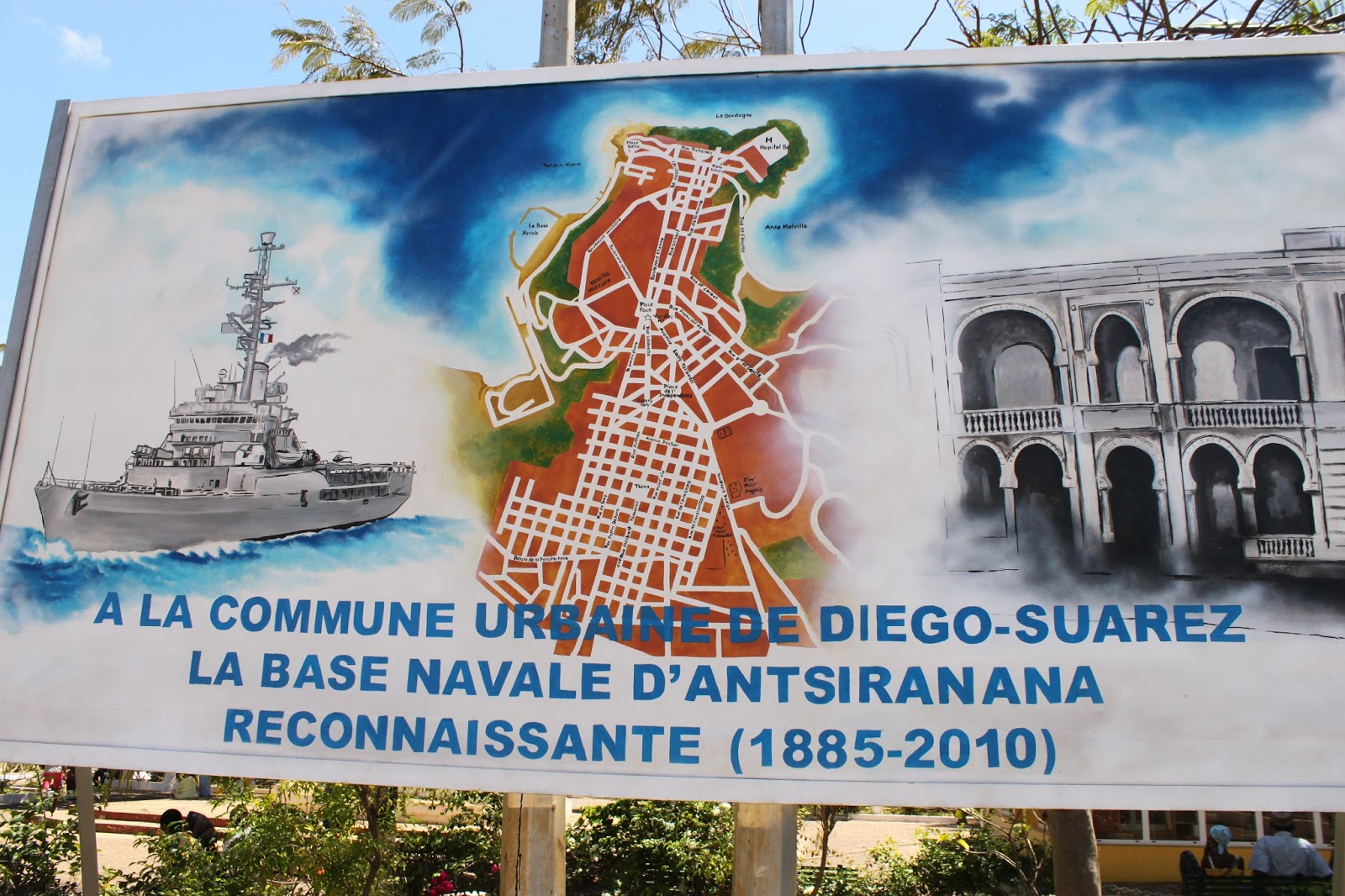
DIEGO Suarez – a huge natural harbour on the northern tip of Madagascar – is the setting for some of the climactic scenes of the book. It was also the final stage of my journey around Madagascar.

Welcome to Diego!

I reached the city in the late afternoon and have two particularly vivid memories of my arrival. The first was the dense perfume of ylang-ylang plants; the second was having a hot shower! By that point I’d been on the road for days and although I’d sometimes had the luxury of running water, that water had never been heated. In Diego I not only stayed in what was recognisably a hotel, it had decent plumbing. I can’t tell you how much I enjoyed that shower. Afterwards I sat on the veranda of my room which overlooked the Indian Ocean. Writing is often a miserable business but on occasions I can think of no better profession.

Diego Suarez was named after two Portuguese admirals: Diego Diaz and Fernando Suarez, which is rather forgiving given that on arrival in 1506 they murdered and enslaved the locals. Despite attempts to revert back to its native name of Antsiranana most people still call it Diego. It is a pleasant port city: a fusion of Indian, African and Arab influences. Bustling and lushly tropical. During my visit hot winds seemed to blow continually. Just outside the city are empty beaches of white sand and azure waves. But I wasn’t here as a tourist. On my first morning I had an appointment at the city’s naval base.

There’s been a military base on the site since the French established one in 1885. From my research for Afrika Reich I knew the Nazis wanted to build a naval fortress here (it’s specifically mentioned in the Bielfeld Memorandum, their blueprint for the continent if they had conquered it). Over the years this fortress had grown in my mind until it became a towering polygon of steel and concrete housing aircraft carriers, submarines and battleships. The reality was...er... rather different. Although the port impressed with its sheer size, it was utterly dilapidated, and with Madagascar being so poor its navy is hardly formidable.

Nevertheless, the Base Commander, the improbably named Randrianarisoa Marosoa Nonenana, was keen to give me a guided tour – and once again this walking the ground proved invaluable when I came to write the final scenes at Diego: from how the landscape tiers down to the water, to the palm trees sprouting among the barracks; the positions of the gun emplacements and the layout of the workshops.


Across the water there was also a huge runway – which gave me an unexpected motive for Salois’s mission. As an aside, in the months before my visit, the US military had been wanting to use the runway as a staging post for bombers to Afghanistan. The appearance of a strange foreigner fuelled all sorts of rumours amongst the Malagasy sailors. In the few hours I was at the base word got back to me that I must be a CIA agent casing the place out. The other alternative – that I was a British writer researching a book – was dismissed as too improbable.


D is also for DIE HARD


Did you get the reference? This is a clue
Many readers of the first book detected multiple references to DIE HARD. As I wrote at the time, none of these were intended, indeed to the best of my knowledge there’s no allusion to the film anywhere in Afrika Reich. Nevertheless people were adamant, so when I came to Madagaskar I thought I’d put an extended reference to the film in the book. Doubtless, this time round no one will identify it as such! Did you spot it?

M is for MANDRITSARA

On a map the journey from Antsohihy to MANDRITSARA looks nothing: 100 miles along Route 32. The reality is a bit more daunting. Although a paved road was built in the 1960s very little maintenance has been carried out since. The annual cyclone season has battered it for decades. We set out at 7am. In a few places the tarmac was fine, but mostly it was as pitted as the lunar surface, including several ‘potholes’ that threatened to swallow up our four-wheel drive. At one point our jeep literally disappeared beneath the surface of the road – something I now regret not photographing. The journey took seven hours – but whatever it lacked in speed was made up for by the sheer drama of the landscape.

Landscape on the road to Mandritsara

I should point out a small detail about the book and my research trip. The Madagaskar Plan is mostly set in April, during the rainy season. I travelled in September when it was dry because many of the roads are impassable during the wet months. So I had to imagine the landscape I saw not as gold and brown and taupe – but as a lush emerald.

Mandritsara is one of the most remote places I’ve ever visited. Even my guide, a native Malagasy with twenty years of tour experience, had never been there. On the long, torturous drive we stopped at a village and so unusual was it to see a tourist that everyone in the village (or so it seemed) wanted to say hello and shake my hand.

Finally, under grey skies and an oppressive heat, we reached Mandritsara. It sits in the Sofia Valley (see R is for...) and in the book is the location of a secret Nazi hospital that conducts unspeakable experiments. There is a real missionary hospital in the town – which is where I stayed during my visit (the town not being over-blessed with alternative accommodation). The hospital – with its courtyards and carmine brick walls – was to become the basis for the hospital in the book, though the latter is on a much bigger scale. I should also add that there is no connection between the two. Indeed the real one is a missionary hospital that does work for the local community and surrounding area. I was shown round by its administrator, Dr David Mann. I always feel humbled by people who give up their lives for the sake of others.

Part of the hospital, as seen from the top of its water tower

It was sobering to see the primitive conditions of the hospital in comparison to what we expect in the west. If ever you complain about the NHS or equivalent – you should come to a place like this. But enough moralising. The tour of the hospital prompted many unexpected ideas for the book. At the end I climbed to the top of the water tower and had a spectacular view of the valley as the sun began to dip. In the distance I could make out another complex of buildings and as dusk approached I went to visit. [Spoiler alert.] It turned out it was an abandoned colonial school from the 50s, and exploring it as the night descended, alone and with a vague sense of foreboding, I had a moment of inspiration for when Burton reaches the hospital at Mandritsara...


M is also for MICROCLIMATE

Later on in my trip I visited Montaigne D’Ambre national park. It has nothing to do with the book (though Salois does mention it towards the end) but since it is a couple hours drive from Diego, and since the chances of me returning are slim, I thought I’d take the opportunity to hike and camp there. One detail about the place I must share.

One of Montaigne D'Ambre's many waterfalls

Montaigne D’Ambre has a MICROCLIMATE, the park being enclosed by a ring of mountains; a microclimate much chillier than the surrounding landscape. I noticed it as soon as I entered the park – but more so as we left. By that point I’d been there three days, three days of cold rain and being wrapped up in T-shirt, shirt, hoodie, jacket, two pairs of socks and a hat. As we (guide, driver and me) left the park we passed out of the micro climate and in the space of no more than ten foot went from being cold to sweltering. It was like stepping through a barrier. We had to stop the jeep, pile out and strip back down to our T-shirts. One of the more bizarre experiences of my trip.


A is for ANTSOHIHY

From Tana I took a plane to Mahajunga (Mazunka in the book, where the radar station is). Internal flights – on the unfortunately named national carrier, Air Mad – are a hair-raising experience of propellers, turbulence and crazy pilots, but necessary given the size of the island. At Mahajunga I was met by my guide and driver who would be my constant companions over the next few weeks of travel; luckily we got on well.

Our first destination was Ankarafantsika National Park where I spent several days trekking through the jungle to get a sense of what it would be like for Burton and the other characters as they moved around the island. Particularly memorable was a night hike, the forest thick and loud with insects and tree frogs. As it happens, nearly all these journey scenes were cut from the book (word length again) but it was still a useful experience to understand the physical demands put on my characters.

Sculpture at the entrance of Ankarafantsika National Park

Next was the town of ANTSOHIHY, a ten hour drive from Ankarafantsika; we had to be there by dusk. Travelling on Madagascan roads is not advisable after nightfall, a combination of poor road conditions (and obviously no lighting), wild animals wandering into your path, and banditry. So we left first thing. In the year the book is set, 1953, the drive would have been through dense jungle but all the forest has long since been cut down. Deforestation is a major issue on the island. Several times on my journey I saw the land either side of me literally being slashed-and-burned. There’s something apocalyptic about travelling along roads bordered with fire.

Antsohihy, or Antzu as it is called in the book, is one of the key locations of the narrative. In reality, it’s a forgotten, nowhere place in the north-west of the island that merited only six lines in my guide book. Tourists rarely come here; it’s one of the most obscure places I’ve ever visited. I arrived at dusk to the most dramatic of sights. A lilac sky, growing darker by the second, and in the distance the ridge of a hill on fire (more slash-and-burn) giving the impression of a great sickle of flame around the town. It was an image I used at the end of Chapter 43.

With little tourism, there’s not much call for accommodation so my base for the next few days would be one of several dilapidated bungalows inside a compound – the closest Antsohihy has to a hotel. The first thing I remember about arriving at the place is the mosquitoes. I’m rarely bitten by insects but the second I stepped out of the jeep the air around me was electrified with them, my arms black and crawling... a detail I incorporated into the book. Another detail which you’ll recognise when you’ve read The Madagaskar Plan was my room: corrugated tin roof, breeze blocks painted white and behind a partition, a bucket of water that was my ‘shower’. Dinner was served in an outbuilding and I assumed I would be the only guest but as I entered I heard voices. English voices. It turned out that the BBC camera crew filming David Attenborough’s series on Madagascar was also in town.

There are no street maps of Antsohihy and wanting the scenes there to be as accurate as possible, the next morning I set out to draw my own. Since foreigners are so rare here, my guide felt uncomfortable leaving me by myself so together we explored the streets and backroads, sometimes on foot, sometimes in the jeep. It was punishingly hot. But the experience furnished me with a wonderful array of details that I could only have learnt by being there. There was the lie of the ground and how the whole town slopes down to the river; an old colonial mansion painted a vile acid green; the abundance of mango trees and great spewing fountains of magenta bougainvillea; a long, snaking road named after a man called Boriziny, though who he was or why the road had been named after him was lost to the inhabitants.

On the final day I made my way to the docks. Antsohihy is on the Analalava River which connects it to the coast. Years ago barges brimming with plantation crops made this journey. Now most of the agriculture has gone. The river is quiet, the docks rotting. And on a warehouse I came across some graffiti. I did try and think of some clever link between it and the end of this section, but the picture probably says it better:


A is also for ANKARANA

After Antsohihy I travelled to Mandritsara (which will be the subject of my next blog entry). Mandritsara is literally on a road to nowhere, so once I finished there I had to retrace my steps and spend another night in Antsohihy before heading north again to the ANKARANA Special Reserve. This doesn’t feature in the book but is worth mentioning for its geological rarity.

Ankarana is a limestone massif that rises out of the jungle. It is a strange and extraordinary landscape, riddled with crocodile caves and one of the few examples in the world of ‘tsingy’: protrusions of limestone that have been eroded by rainwater to form jagged pinnacles. Too sharp and delicate to walk on, you view them from above on swaying bridges that reminded me of that scene in Indiana Jones & the Temple of Doom.


T is for TANA

Standing where Hochburg stands

TANA – or to give it its full name Antananarivo (literally: the city of a thousand warriors) – is the capital of Madagascar. It’s a long journey there: London to Paris for the connecting flight, then eleven hours down and across Africa to the Indian Ocean and southern hemisphere. Arriving was not for the faint-hearted. The plane landed at what looked like an abandoned airport. Along with four hundred fellow passengers I had to hurry across the tarmac into a suffocatingly humid arrivals hall. There were no queues, just an interminable scrum to get through. Immigration documents had to be filled out by hand, in triplicate, and presented to two different desks in order to get my passport stamped. The diary I kept while travelling simply reads, ‘ABSOLUTE CHAOS’. However, no matter how wearing it was (the heat, the press of bodies, screaming babies, an hour to get to the front), it occurred to me that it would have been nothing compared to the bedlam millions of Jews would have faced arriving in Nazi Madagaskar.

Next morning I began my exploration of Tana proper. I was staying in the suburbs and to get to the centre had to drive past shanty towns and brick factories, paddy fields, and canal banks with literally miles of washing laid out to dry on them. Tana reminded me of many big Africa cities: overcrowded, chaotic and slightly shabby, a bricolage of colonial architecture and more recent concrete blocks. It was also full of colour and a vibrancy that cities in the developed world just don’t possess. The lower town is truly labyrinthine, navigation around it made all the harder by the fact many streets don’t have names or that the names change regularly depending on which dictator is in power.

My most vivid memory is the main marketplace, especially the butchers where sausages and great racks of zebu rib (the local cattle) hung beneath red canopies, dripping blood and buzzing with flies. There was no sign of any refrigeration. I’ll leave the smell to your imagination.


Tana is built on a twelve hills, the highest of which is crowned with Queen Ranavalona I’s palace. Erected in the mid-19th century, it was destroyed by fire in 1995, leaving just the stone shell and has been in a state of permanent renovation since. From here I had a spectacular view across the plains as they shimmered in a heat haze. A warm breezed licked my face... just the way it does when Hochburg stands in the same spot in Chapter 16. The palace was the model for Globus’s headquarters in the book, not least because its rocky foundations are steeped in blood. Ranavalona, known as ‘the wicked queen’, was notorious for hurling those who displeased her off the walls of her palace. It seemed an appropriate base for the SS.


T is also for TAFT

[Spoiler alert.] One of the arcs that runs through the trilogy is America’s involvement in Africa: from disengagement in Afrika Reich through to being a full player in Book 3. America’s role in the world order is a key part of the plot in Madagaskar. For this I needed a president who was isolationist but not slavish so, as well as one with an ambiguous attitude to the fate of the Jews. At first I thought of making up a character, but given that most of the historical figures in the book are real, I felt obliged to do the same with my president. So I started scouring all presidential candidates and hopefuls of the 1940s and early 50s.

The biggest difficulty with this was how real history affected my choices. For example, Eisenhower became president partly on a war-hero ticket; other candidates were popular because they were tough on Communism, a stance that makes little sense in my world. I therefore had to disentangle these elements from my selection. Luckily, one figure soon came to the fore: Robert A. TAFT, a senator from Ohio and son of William Taft, the 27th President.


Taft had narrowly missed securing the Republican Party’s nomination for president against Eisenhower in 1952, so was a highly credible possibility given my altered timeline. Taft had another advantage. He died in July 1953 – i.e. three months after the events of Madagaskar – so if the narrative for Book 3 changes I have an excuse to ditch him!

Saturday, 23 January 2016

T(1) is for TRAVEL, an introduction

Blink... and five months have passed since I last posted an entry on this blog. Where does the time go? It’s quite shocking the speed at which life passes. Anyway, I’m soon to be moving on to pastures new so I’m going to make a determined effort to finish this blog. Expect an entry a week now till it’s done. This new determination is going to start with the TRAVEL I undertook for The Madagaskar Plan.

One of the things that disappointed me about the first book was that I never visited the places I was writing about (see Q is for...). Mostly this was because they were too dangerous. Although Madagascar is one of the poorest countries on the planet, it is safe; so for the second book I was determined to travel there and walk the same ground as my characters. There’s something about being in the real locations that gives you an edge over just reading about them: it’s understanding the topography from a specific point; the hue of the light at sunset; the smell of the earth. All details you could never imagine.


Another reason for making the trip was that some of the locations in The Madagaskar Plan were so obscure there’s very little information about them to be found anywhere, either on-line or in specialist libraries. Going was the only way of knowing.


Early on in the plotting of Madagaskar I knew Burton would follow a certain route and I wanted to travel it myself. So I’m going to dedicate several entries in this blog to the places I visited, starting with Tana, one of the key locations for the exchanges between Hochburg and Globus, the governor of Madagaskar.

Before then you can get a preview of my research trips in this piece I wrote for Bookbrunch:

Click here to read on...

Sunday, 23 August 2015

I is for INFLUENCES

The Afrika Reich was very consciously influenced by other works: from Conrad’s Heart of Darkness to films like Where Eagles Dare, from which I took the ‘Men on a Mission’ formula and played around with it. Writing The Madagaskar Plan I made an equally conscious effort to be less influenced.

That’s not to say the book is without INFLUENCES. I’ve already mentioned The Empire Strikes Back; and Sergio Leone looms large again, especially in the fantastic realism and interweaving narrative strands. I also drew on Marek Edelman’s accounts of the Jewish uprising in Warsaw (which inspired the infighting between the Jews in the face of annihilation) as well as childhood passion for Homer.

In terms of other literary influences, two books were significant: William Boyd’s An Ice Cream War and The Great Gatsby, though traces of them may be hard to discern. The Boyd is set during the East African campaigns of World War I, all German colonialism, suffocating cities and rain lashed jungles. It helped with the tone. As did Gatsby which constantly made me reflect on the purpose of characterisation and concentrated my mind on sentences that were fresh and precise. I suppose these two books were like stabilisers on a bike: I had them either side of me during the first drafts but eventually freewheeled off in my own direction. Having said that, one scene in Madagaskar was heavily influenced by Gatsby – the ‘showdown’ between Jay, Tom and Daisy in the Plaza Hotel... expect in my version I’ve added the danger of a loaded pistol.

Levi, Boyd & FSF

Another important book, for obvious reasons, was Primo Levi’s If Not Now,When? a novel based on the true story of Jewish partisans fighting the Nazis. This informed much of the background of the Jewish uprising and specifically Salois’s character. Levi’s novel is replete with extraordinary, vivid details. For example, one of the things I’d never considered before was how hungry freedom fighters must be surviving in the wilderness. Hunger was also a painful motif from Marek Edelman and so it became a central theme in the Madagaskar. On a more light hearted note, my favourite scene in If Not Now, apparently based on fact, is when Gedaleh gathers the pumpkins. For all its bitter logic there’s something rather Leonesque about it, which is why I have Burton and Tünscher do the same in Chapter 33.